For over a decade, NASA has been sending laser signals to its Lunar Reconnaissance Orbiter (LRO) without success—until now. Researchers captured the first returning signals just months ago.
Since the LRO entered lunar orbit in 2009, NASA scientists have targeted its compact, book-sized retroreflectors with laser beams, aiming to bounce light back to Earth. After years of failed attempts, teams finally detected these elusive photons.
This marks the first successful reflection of photons from lunar orbit back to Earth, opening new avenues for precise measurements. It also sheds light on why Apollo-era reflectors on the lunar surface, installed over 50 years ago, are fading rapidly.
Between 1969 and 1972, Apollo astronauts deployed three laser retroreflectors on the Moon. By timing the laser beams' round trip, scientists have precisely measured the Earth-Moon distance, revealing the Moon drifts away at about 3.8 cm per year.
Over time, these surface reflectors have dimmed by up to 10%, with lunar dust likely playing a key role. To investigate, researchers shifted focus to the LRO's orbital reflector, avoiding surface debris interference.
Comparing orbital and surface signals could reveal micrometeorite impacts and dust dynamics on the Moon.
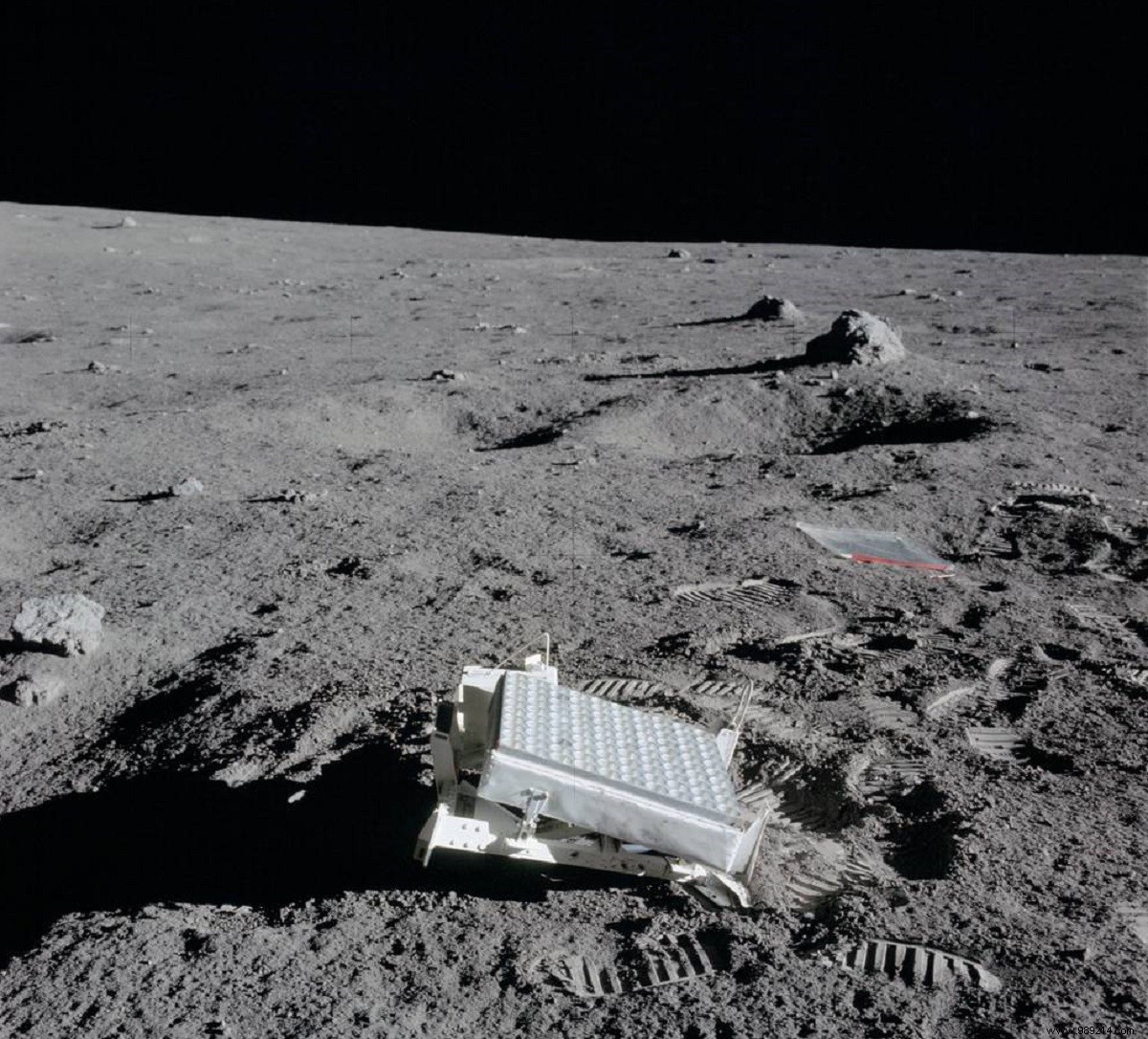
Hitting a 15 x 18 x 5 cm target orbiting at over 384,000 km, amid Earth's atmospheric turbulence, proved challenging. Initial green laser tests failed.
Two years ago, NASA partnered with experts from the University of Côte d'Azur in France, switching to an infrared laser that pierces clouds and gases more effectively, minimizing atmospheric distortion.
On September 4, 2018, the Grasse laser station in Alpes-Maritimes recorded the first signal from the LRO.
Success repeated on August 23 and 24, 2019, even after reorienting the spacecraft for optimal reflector alignment—eliminating wait times for natural positioning.
Though only a few photons have returned so far, ongoing experiments promise deeper insights into lunar reflector degradation.
