A team of astronomers has announced the observation of a long-theorized type of binary star system featuring extremely low-mass (ELM) white dwarfs. The findings are detailed in Monthly Notices of the Royal Astronomical Society.
Nearly 97% of stars in the universe end their lives as white dwarfs—compact, dense remnants that have exhausted their nuclear fuel and faded in luminosity. Our Sun will follow this path. In rare instances, stars evolve into extremely low-mass (ELM) white dwarfs, with just one-third the mass of the Sun.
These enigmatic objects have long challenged astronomers. Early models suggested all white dwarfs should be older than 13.8 billion years—the age of the universe itself—making ELMs physically implausible if formed in isolation.
Researchers eventually determined that binary interactions were key. The gravitational influence of a companion star can strip away a star's outer layers rapidly, within less than 13.8 billion years, leaving behind an ELM white dwarf.
While we've observed Sun-like stars paired with white dwarfs and ELM white dwarfs with standard white dwarf companions, the crucial transitional stage—where a white dwarf is contracting into a pre-ELM—had evaded detection until now.
Lead author Kareem El-Badry likens stellar astronomy to 19th-century zoology: "You venture into the jungle, describe an organism's size and weight, then move to the next. Here, we observe diverse stellar objects and connect the evolutionary dots."
In 2020, El-Badry hunted for the elusive pre-ELM white dwarf.
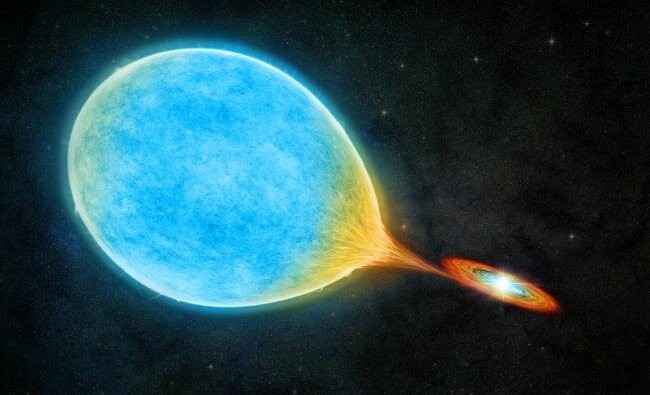
Leveraging the Shane Telescope at Lick Observatory (California), ESA's Gaia data, and the Zwicky Transient Facility at Palomar Observatory, he narrowed a billion candidates to about 50, then to 21 confirmed pre-ELM white dwarfs. These stars appeared slightly bloated and egg-shaped due to their companion's tidal forces. Thirteen were actively losing mass to their partners, while eight had ceased.
"We uncovered the evolutionary bridge between two binary star populations," El-Badry notes, crediting public surveys: "Without Gaia and the Zwicky Transient Facility—powered by hundreds of experts—this discovery wouldn't have been possible."
