Cats' exceptional adaptability has profoundly influenced astronaut training, enhancing their ability to navigate microgravity environments.
Cats are renowned for their ability to right themselves mid-fall, a trait that has informed space research. As noted in a Popular Mechanics article from August 24, 2020, scientists have leveraged feline movements to improve astronaut performance in weightlessness, particularly during high-risk extravehicular activities (EVAs) that involve exiting spacecraft.
NASA documents reveal that researchers placed cats in astronaut training devices to study their reactions in the field of bioastronautics.
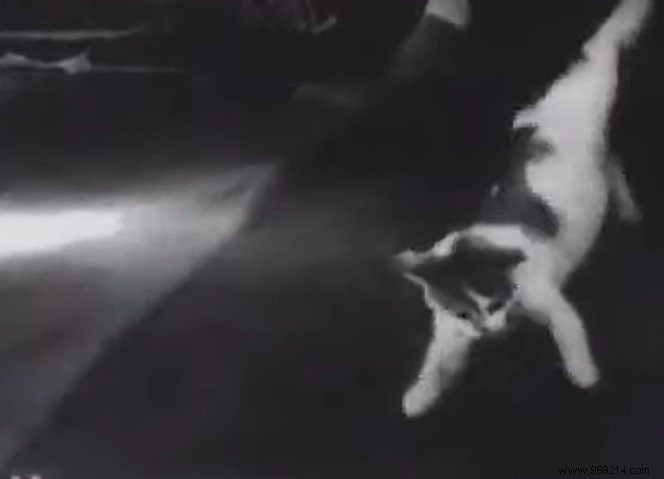
France pioneered feline spaceflight in 1963 with survival rocket tests; one cat, Félicette, survived and was recovered. Earlier U.S. Air Force experiments in the late 1940s observed cats during "zero G" parabolic flights on a Convair C-131, simulating weightlessness (see video at article's end).
In 1969, Stanford University researchers, partially funded by NASA, published findings in the International Journal of Solids and Structures. They modeled the falling cat using hinged cylinders to derive differential equations explaining the physics, enabling NASA to refine astronaut orientation techniques in microgravity.
In 2012, engineer Destin Sandlin analyzed vintage NASA footage, replicating experiments to demonstrate cats exploit the gyroscopic effect via their inner ear, allowing precise body twists to land on their feet.
