Billions of years ago, Mars resembled a younger Earth, with a thick atmosphere, flowing rivers, and a protective magnetic field generated by its molten core. But today, its atmosphere is razor-thin, eroded by solar winds—largely due to the loss of that magnetic shield. Recent research from the University of British Columbia (UBC) sheds new light on when and how this critical field vanished.
Long ago, Mars boasted a warmer, denser atmosphere and surface liquid water, possibly even supporting life. Like Earth, it sustained a global magnetic field from dynamo action in its liquid outer core. When this dynamo failed, solar winds began stripping away the atmosphere, transforming the planet into the barren world we know.
Scientists once thought Mars' magnetic field died out over 4 billion years ago. However, UBC researchers, analyzing data from NASA's MAVEN orbiter, have refined this timeline, showing the field persisted hundreds of millions of years longer than previously estimated.
Mars' magnetic field arose from convective motions in its fluid outer core swirling around a solid inner core, counter to the planet's rotation—much like Earth's geodynamo. But Mars, smaller and less dense than Earth, cooled faster internally. This solidified its outer core, halting the dynamo and leaving the atmosphere vulnerable.
Current models suggest Mars' innermost core remains liquid due to insufficient internal pressure to freeze it solid.
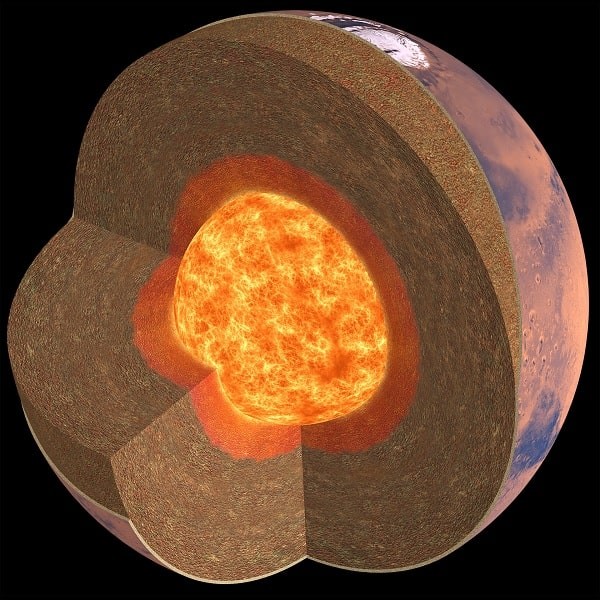
Planetary scientists study ancient magnetic fields by examining magnetized rocks, especially volcanic ones from the mantle extruded during eruptions. As lava cools on the surface, magnetic minerals align with the prevailing global field, preserving a record.
Past analyses of surface rocks indicated dynamo activity 4.3 to 4.2 billion years ago. Rocks from major basins like Hellas, Argyre, and Isidis—formed around 3.9 billion years ago—suggested the field had ceased by then.
Yet, fresh MAVEN data reveals a different story. Measurements over the Lucus Planum lava flows, dating to about 3.7 billion years ago, show clear magnetic signatures. This groundbreaking evidence, published by UBC experts, confirms Mars' magnetic field endured far later than earlier regional studies implied, reshaping our understanding of the planet's habitability window.
