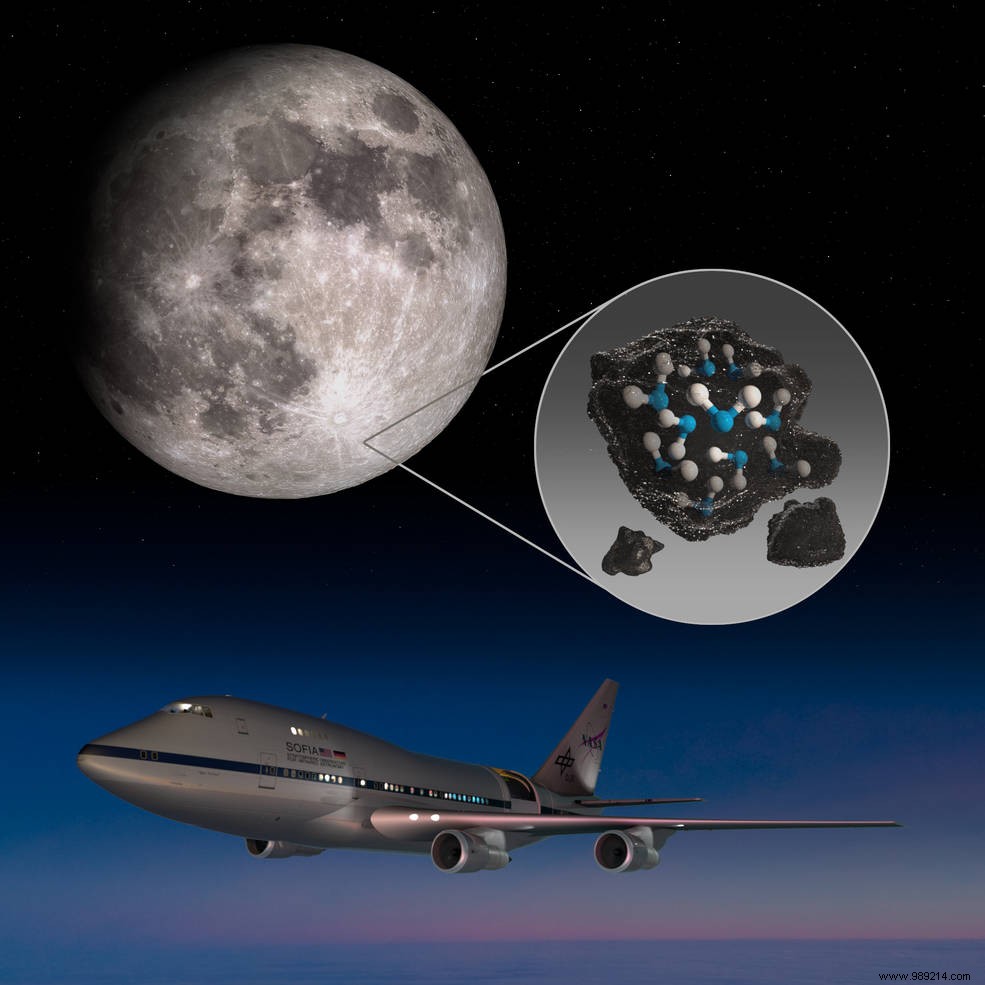
NASA's Stratospheric Observatory for Infrared Astronomy (SOFIA) has detected water molecules (H2O) on the Moon's sunlit surface for the first time—a key step forward for lunar exploration.
NASA recently hinted at an "exciting discovery about the Moon" from SOFIA, a cutting-edge airborne infrared telescope jointly developed by NASA and the German Aerospace Center in the 2000s.
As the world's largest airborne observatory, SOFIA operates from a modified Boeing 747, flying at 12,000 to 13,000 meters—above 99% of Earth's water vapor—for unparalleled views of the universe and solar system objects, as NASA explains.
Turning its gaze to our nearest neighbor, SOFIA delivered groundbreaking results. Paul Hertz, director of NASA's Astrophysics Division; Jacob Bleacher, chief exploration stratigist for NASA's Human Exploration and Operations Mission Directorate; and Naseem Rangwala, SOFIA project scientist, shared the findings.
SOFIA confirmed water molecules in the Clavius crater, one of the largest craters visible from Earth in the Moon's southern hemisphere.
Prior observations hinted at water's presence, but couldn't differentiate it from hydroxyl (OH). SOFIA's data reveals concentrations of 100 to 412 parts per million per cubic meter of lunar regolith—far less than the Sahara Desert, which holds about 100 times more.
"We had indications that H2O—the water we know—might be present on the sunlit side of the Moon," said Paul Hertz, director of the Astrophysics Division at NASA Headquarters. "Now we know it is there."
This discovery sparks key questions: How did the water arrive, and how does it persist?
"Without a thick atmosphere, water on the sunlit lunar surface should vaporize into space," notes Casey Honniball of NASA's Goddard Space Flight Center. "Yet it's there somehow—so something creates it, and something traps it."
Possible sources include micrometeorites delivering water or solar wind protons reacting with oxygen-rich lunar minerals to form hydroxyl, which micrometeorite impacts may convert to water. For storage, tiny glass beads from impacts or shadowed pockets between soil grains could shield it from sunlight.
Whether this water is accessible for NASA's Artemis program—aiming for crewed landings by 2026 and sustainable presence—remains unclear. Volumes are tiny: as astronomer Jessica Sunshine noted, collecting all H2O from a football-field-sized area yields less than a liter.
