Are we alone in the universe? For decades, astronomers and scientists have pondered this question and taken bold steps to signal our presence to potential extraterrestrial civilizations. Here's a look at the key messages humanity has dispatched into the cosmos.
It began in 1962 when Soviet researchers directed a radio transmitter toward Venus, broadcasting a greeting in Morse code: Mir (meaning "peace" and "world" in Russian), Lenin, and SSSR (the Latin acronym for the Soviet Union). This symbolic effort primarily tested a new radar for mapping Solar System objects.
In 1969, Apollo 11 astronauts affixed a commemorative plaque to the Moon's lunar module. It features a depiction of Earth and a peace message from U.S. President Nixon.
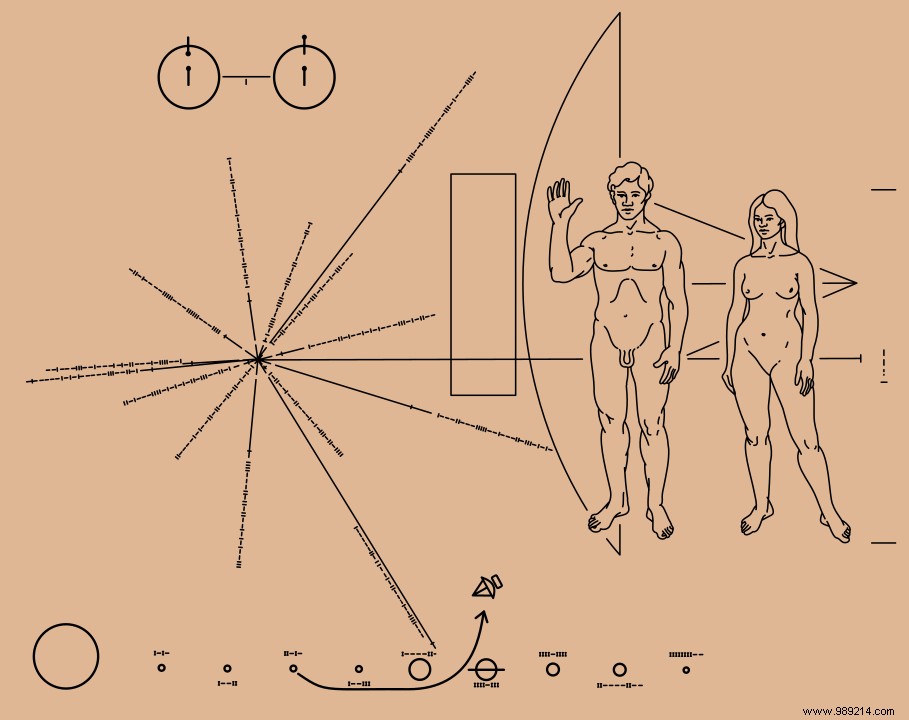
Pushing further, NASA attached a gold-anodized aluminum plaque to Pioneer 10, launched in April 1972. Designed by astronomers Carl Sagan and Frank Drake, with artwork by Linda Sagan, it illustrates a nude man and woman representing humanity (the man raises his right hand in greeting), a hydrogen atom, and our Solar System highlighting Earth's position. It also shows the probe's trajectory relative to human scale and the pulse rates of 14 pulsars, enabling triangulation to locate our Sun.
In 1974, Sagan, Drake, and colleagues transmitted a binary-encoded radio signal from Puerto Rico's Arecibo Observatory toward the Messier 13 star cluster, about 25,000 light-years away. Any reply would take at least 50,000 years. The message depicts a human figure with our average height, Earth's 1974 population (about 4 billion), the Solar System, a DNA double helix, a carbon atom, and the Arecibo telescope itself.

Beyond radio waves, we launched physical artifacts aboard Voyager 1 and 2, launched in 1977, to explore the Solar System's outer reaches. Each carries a gold-plated record with Earth's sounds—music, natural ambiences—and 116 images of our world and solar system. Included are a stylus for playback and uranium-238 (half-life of 4.5 billion years) to date the launch.

Will these messages be discovered and understood? Experts note the odds are slim. Success hinges on intelligent life intercepting them, decoding radio signals or artifacts, and sharing our sensory perceptions of sound and sight.
