Eleven years of Hubble Space Telescope observations show winds in the outermost lane of Jupiter's Great Red Spot gaining speed. The cause is still unknown, but new findings are detailed in Geophysical Research Letters.
The Great Red Spot, a massive anticyclone observed for over 400 years, dwarfs Earth's longest-lasting storm, Hurricane John, which endured just 31 days in 1994. Picture it as a counterclockwise vortex trapped between oppositely moving jet streams racing at up to 350 km/h, sustaining its immense power—and now, that power appears to be shifting.
Astronomers analyzing Hubble data found that average wind speeds in the storm's high-speed outer ring surged 8% from 2009 to 2020, reaching nearly 650 km/h.
"No one has seen this before," says Michael Wong, planetary scientist at the University of California, Berkeley. "It's something only Hubble can achieve." Unlike Earth storms tracked by satellites and aircraft, Hubble uniquely monitors Jupiter's dynamics with unmatched precision.
Hubble's endurance enabled this detection: the acceleration averages less than 2.5 km/h per Earth year. "These are tiny changes—without 11 years of data, we'd miss them entirely," Wong notes. "Hubble gives us the resolution to confirm the trend."
In contrast, winds in the spot's core crawl at human walking pace.
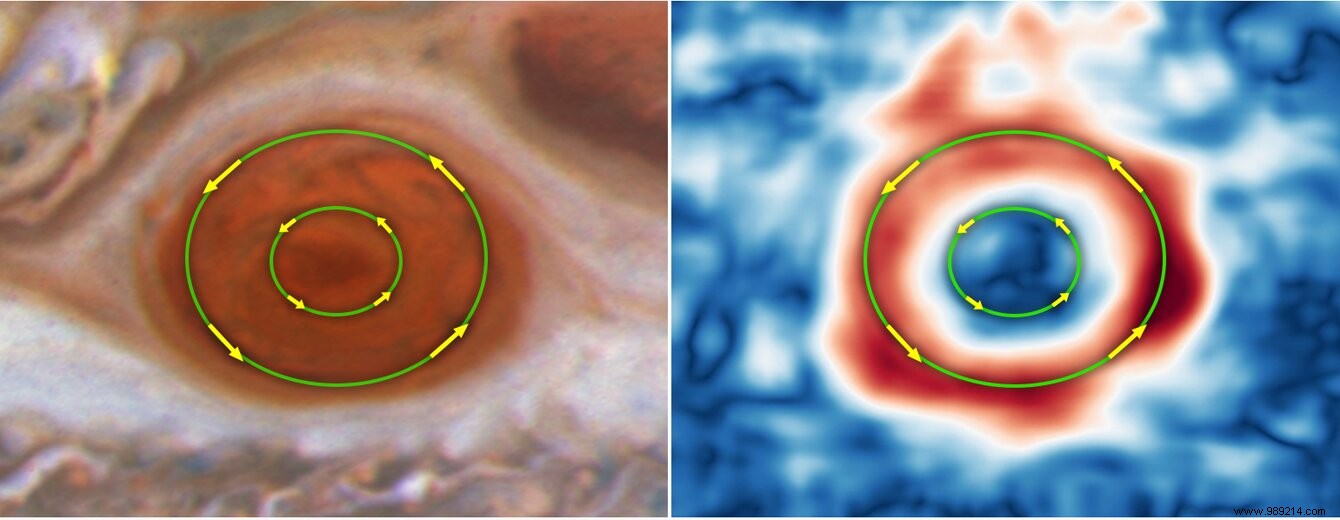
What drives this speedup? "It's challenging without visibility below the clouds," Wong explains. "Yet this data illuminates what fuels the Great Red Spot and sustains its energy. Much research lies ahead."
Meanwhile, the Great Red Spot keeps shrinking: from four times Earth's diameter in the late 1800s, to over twice by Voyager 2's 1979 flyby, now just 1.3 times. It may vanish in 20-30 years, but it remains the Solar System's largest storm.
