Poets and authors often evoke the profound, abyssal darkness of deep space. Gazing into interplanetary, interstellar, or intergalactic voids, our eyes meet near-total blackness. Even Earth's star-filled night sky appears dark. Yet, with the universe brimming with light-emitting and reflecting objects, why this pervasive darkness?
Peer at the night sky or browse cosmic images online, and space consistently reveals its deep void, dotted by brilliant stars, planets, or spacecraft. Why isn't it vibrant like Earth's daytime blue sky? Surprisingly, the explanation isn't just a lack of light.
“You would think that since there are billions of stars in our galaxy, billions of galaxies in the universe, and other objects like planets that reflect light, the night sky would be extremely bright. But instead, it's really, really dark,” explains Tenley Hutchinson-Smith, an astrophysicist at the University of California, Santa Cruz (UCSC).
Hutchinson-Smith attributes this to Olbers' paradox, resolved by the theory of expanding space: “because our Universe is expanding faster than the speed of light... light from galaxies could stretch and transform into infrared waves, microwaves, and radio waves, which are not detectable by our human eyes.” These invisible wavelengths make distant objects appear black to the naked eye.
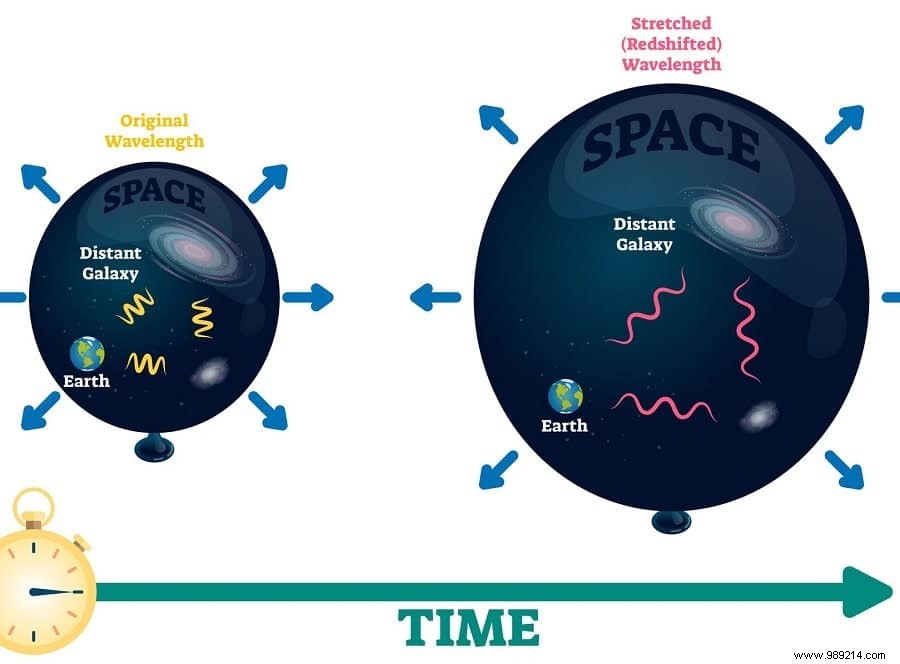
Stars emit light across all colors, including ultraviolet and infrared beyond human vision. If we could detect microwaves, space would glow uniformly. This stems from the cosmic microwave background—the first photons released 380,000 years after the Big Bang following recombination—which still permeates the cosmos.
Interstellar and interplanetary space appears dark partly because it's an almost perfect vacuum. Earth's blue sky results from atmospheric molecules like nitrogen and oxygen scattering sunlight's blue and violet wavelengths toward our eyes.
In space's void, with scant particles, light travels straight from source to observer unimpeded. Without scatterers, no light reaches our eyes, yielding darkness.
That said, a 2021 study in The Astrophysical Journal challenges this view. Using NASA's New Horizons mission data from beyond Pluto and the Kuiper Belt—free of Earth and Sun light pollution—researchers analyzed images, subtracting known stellar, Milky Way, galactic, and instrumental light. Surprisingly, the cosmic background was twice as bright as predicted.
