All matter in the universe consists of atoms—tiny building blocks with a positively charged nucleus of protons and neutrons, surrounded by negatively charged electrons. The balance of these particles defines each element on the periodic table and dictates chemical interactions. So, how many atoms populate the observable universe?
To put it in perspective, an average human body contains about 7 octillion atoms, or 7×1027 (7 followed by 27 zeros). Scaling that to the entire universe seems impossible, especially since the universe's full extent remains unknown. However, astronomers can estimate the atom count in the observable universe—the portion we can see and study—using established cosmological models and data.
The universe originated in the Big Bang 13.8 billion years ago. Its expansion has accelerated for at least the past 6 billion years, yielding a current observable diameter of about 90 billion light-years.
Einstein's E=mc² shows matter and energy are interchangeable, but on cosmic scales, creation and annihilation of matter roughly balance out. Thus, the total number of atoms in the observable universe remains constant over time—crucial for our calculations, which draw from observations spanning billions of years.
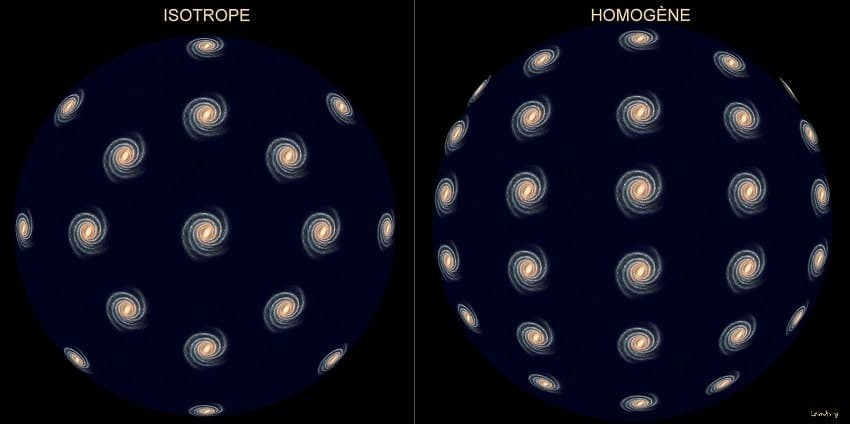
Observations confirm uniform physical laws across the cosmos. Paired with steady expansion, this supports the Cosmological Principle: matter is evenly distributed on large scales. No overcrowded regions exist, enabling reliable tallies of stars and galaxies—where most atoms reside.
First, we approximate that all atoms are in stars, though some exist in planets, moons, and interstellar gas. Stars hold the vast majority, and precise counts for other bodies are elusive, so this yields a solid estimate.
Second, we treat all atoms as hydrogen, which comprises ~90% of cosmic atoms (per Los Alamos National Laboratory) and even more in stars. This streamlines math without significant loss of precision.
To find the atom count, start with the observable universe's mass, dominated by stars. Estimates from the European Space Agency place 1011 to 1012 galaxies, each with 1011 to 1012 stars—totaling 1022 to 1024 stars. We'll use 1023 for our figure (noting galaxy sizes vary).
An average star masses ~1032 kilograms, so the stellar mass reaches ~1055 kilograms.
Fermilab data shows ~1024 protons per gram of matter. Since hydrogen has one proton per atom, multiply: 1055 kg × 1,000 g/kg × 1024 protons/g = 1082 atoms.
That's 1 followed by 82 zeros—a mind-boggling 10,000,000,000,000,000,000,000,000,000,000,000,000,000,000,000,000,000,000,000,000,000,000,000,000,000,000 atoms.
