The solar wind is a continuous stream of charged particles—primarily protons and electrons—emitted by the Sun, permeating the entire Solar System. First theorized in the 1950s by University of Chicago physicist Eugene Parker, it's observable as the Sun's halo during eclipses or in auroras like the Northern Lights when particles interact with Earth's atmosphere. While it generally shields our planet from galactic cosmic rays, intense solar wind storms can disrupt satellites and communication networks.
The Sun's surface reaches about 5,500°C, yet its outer atmosphere, the corona, soars to over a million degrees. As an active star, the Sun experiences frequent magnetic eruptions. This extreme heat overcomes solar gravity, propelling particles into space at speeds up to 1 million kilometers per hour, forming the solar wind that sweeps past Earth.
This particle flow influences our planet profoundly: it deflects harmful cosmic rays but can trigger geomagnetic storms affecting telecommunications. NASA studies it closely due to risks for astronauts in space.
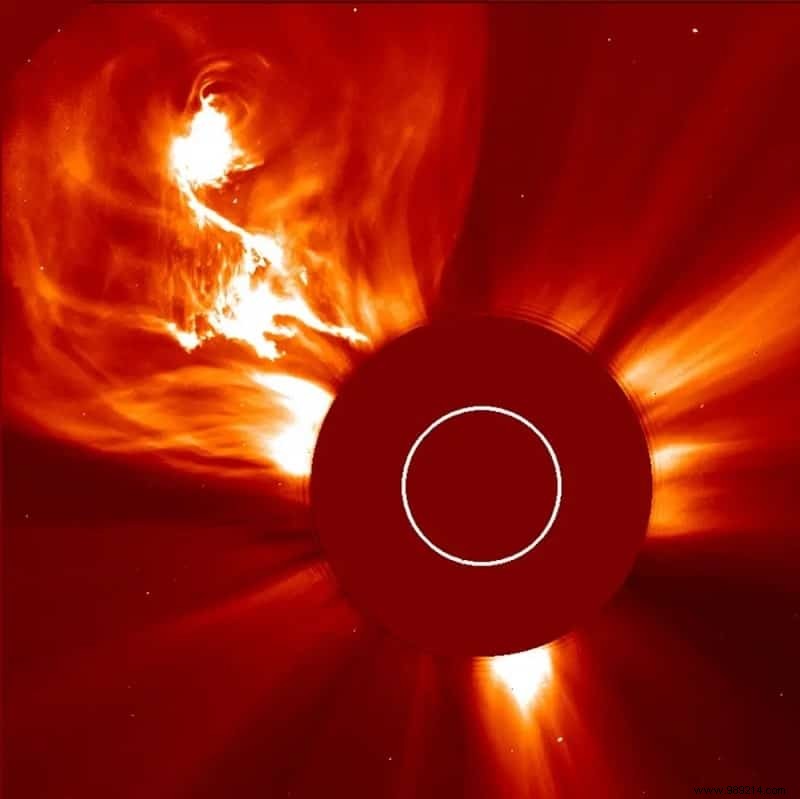
Earth's magnetic field typically deflects most solar wind particles. However, coronal mass ejections (CMEs)—massive bursts of up to a billion tons of solar material traveling at thousands of kilometers per second—can overwhelm this shield, potentially devastating infrastructure.
A major CME could disrupt radio communications for aircraft, skew GPS by kilometers, and cripple banking, power grids, and electronics. History bears this out: the 1859 Carrington Event, a massive solar flare, knocked out telegraph systems for days. Auroras were so vivid people read newspapers by their light at midnight in low latitudes.
In our tech-dependent era, a similar event could be catastrophic. A 2013 Lloyd's of London study estimated up to $2.6 trillion in U.S. damages alone from blackouts and grid failures.
Early warnings could enable safeguards like powering down satellites. NASA's fleet of solar-observing spacecraft provides images, offering minutes to hours of notice once eruptions surface. Yet, truly predictive models remain elusive.
Deeper solar wind insights are vital for space exploration too. High-energy particles can erode spacecraft shielding and harm humans. NASA seeks to map their composition, speed, and patterns to forecast space weather and ensure safe missions.
