A recent study in The Astrophysical Journal reveals that up to seven habitable planets could orbit a single star under ideal conditions. In our solar system, Jupiter likely played a limiting role.
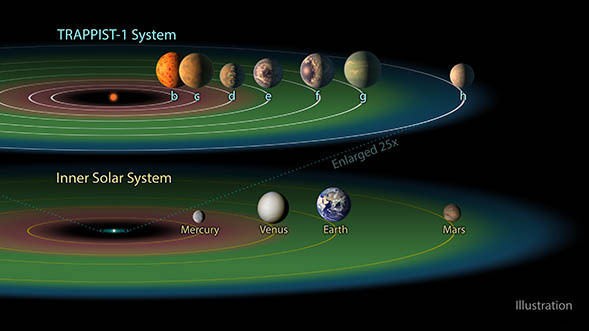
Discovered in 2017 just 39 light-years from Earth, the TRAPPIST-1 system has captivated astronomers. This remarkable setup features a star orbited by seven rocky, Earth-sized planets, with three in the habitable zone. Under the right circumstances, one or more could potentially support life.
Inspired by TRAPPIST-1 and recent discoveries of rocky exoplanets around nearby stars, astronomer Stephen Kane and his team at the University of California, Riverside, investigated: what's the maximum number of habitable planets a star can support?
Planetary dynamics teach us that habitable worlds can't be packed too closely, as gravitational interactions would destabilize their orbits. To find the limit, Kane's team ran detailed computer simulations.
Their findings are clear: maintaining safe orbital spacing for life-friendly conditions allows for up to seven habitable planets around one star.
For a habitable zone spacious enough to fit seven such worlds, the star needs to be 10 to 20% more massive than the Sun. Additionally, the planets must follow circular orbits to minimize interference risks.
The absence of a Jupiter-like giant would help. Kane's analysis indicates Jupiter restricted our solar system's potential. For a Sun-like star, the maximum is six habitable planets—a solid number, yet we have just one confirmed.
"Jupiter has profoundly influenced our Solar System's habitability; it's massive—two and a half times the combined mass of all other planets—and disrupts neighboring orbits," Kane explains.
Next, astronomers will hunt for stars hosting multiple Earth-like exoplanets. Beyond TRAPPIST-1, the Sun-like G-type star Beta Canum Venaticorum (Beta CVn)—used as a model in the study—stands out as a candidate.
No exoplanets are confirmed around Beta CVn yet, which is promising: it suggests no massive giants are present (which would have been detected). Future observations with advanced telescopes could reveal smaller worlds.
These next-generation instruments, with superior optics and sensitivity, will analyze light from planetary atmospheres to detect potential biosignatures.
