Astronomers have announced the discovery of a vast "cloud wall" spanning thousands of miles, circling Venus. This marks the first observation of such a phenomenon anywhere in our Solar System.
Venus serves as an extreme atmospheric laboratory. Its dense carbon dioxide envelope rotates 60 times faster than the planet itself, fueling powerful winds. Surface temperatures average a scorching 471°C, with atmospheric pressure 100 times greater than Earth's.
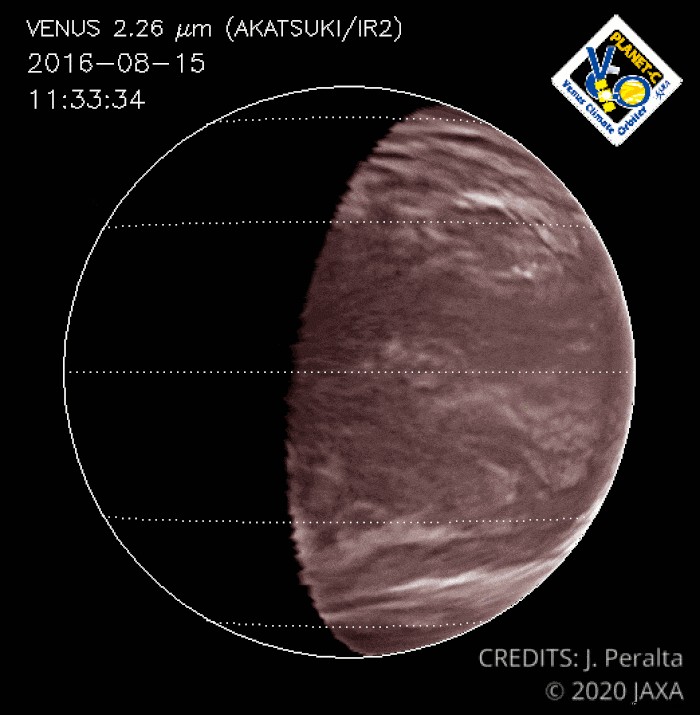
This dynamic atmosphere fosters enormous cloud waves. Researchers from Japan's Aerospace Exploration Agency (JAXA) identified one using data from the Akatsuki orbiter, captured between 2016 and 2018.
The structure resembles an atmospheric wave but originates deeper in the clouds—between 47.5 and 56.5 km altitude—within the layer driving Venus's intense greenhouse effect.
Stretching 7,500 kilometers, this "cloud wall" hurtles eastward along the equator at over 328 kilometers per hour, completing a full orbit in just 4.9 Earth days. Comparable clouds at these heights take about 5.7 days.
Data suggests it formed several decades ago, as early as 1983, though its origins remain unknown.
“This atmospheric disturbance is a new weather phenomenon, unseen on other planets. For this reason, it is still difficult to provide a confident physical interpretation,” notes Pedro Machado from Portugal's Institute of Astrophysics and Space Sciences. Further observations are ongoing to unravel this mystery.
Despite its harsh environment, Venus draws intense scientific interest. India's space agency plans a probe to delve deeper into its surface and atmosphere, potentially launching in 2023.
Researchers have also proposed ray-like aircraft to sample its atmosphere more effectively.
NASA is advancing the Automaton Rover for Extreme Environments (AREE), a rugged, fully mechanical rover designed to analyze diverse geological features on Venus's surface.
Past missions have struggled to endure: the record belongs to Venera 13, which sent 22 photos and analyzed a rock sample in 1982 before succumbing after 127 minutes.
