Acclaimed amateur astronomer Yuji Nakamura has captured a spectacular nova in Cassiopeia—a star's explosive transformation, still visible tonight through binoculars for Northern Hemisphere observers.
A nova occurs when a star experiences a sudden surge in brightness, flaring up dramatically for days to weeks before fading back to its original state. This captivating event unfolds in binary systems featuring a white dwarf paired with a companion evolving into a red giant.
The red giant sheds mass, which forms an accretion disk around the white dwarf. This material eventually crashes onto the dwarf's surface, compressing and heating to around 10 million kelvins. The extreme conditions ignite a thermonuclear explosion—and boom: a nova is born.

On March 18, Yuji Nakamura spotted a striking new point of light in the iconic Cassiopeia constellation. Experts at Kyoto University swiftly confirmed the event using the 3.8-meter Seimei Telescope on Mount Chikurinji, Japan. Spectral analysis verified PNV J23244760+6,111,140 as a classical nova.
Initially at magnitude 9.6, it brightened to 9.1 within hours and reached magnitude 7.8 by March 19. Lower magnitudes mean greater brightness—perfectly observable with standard binoculars.
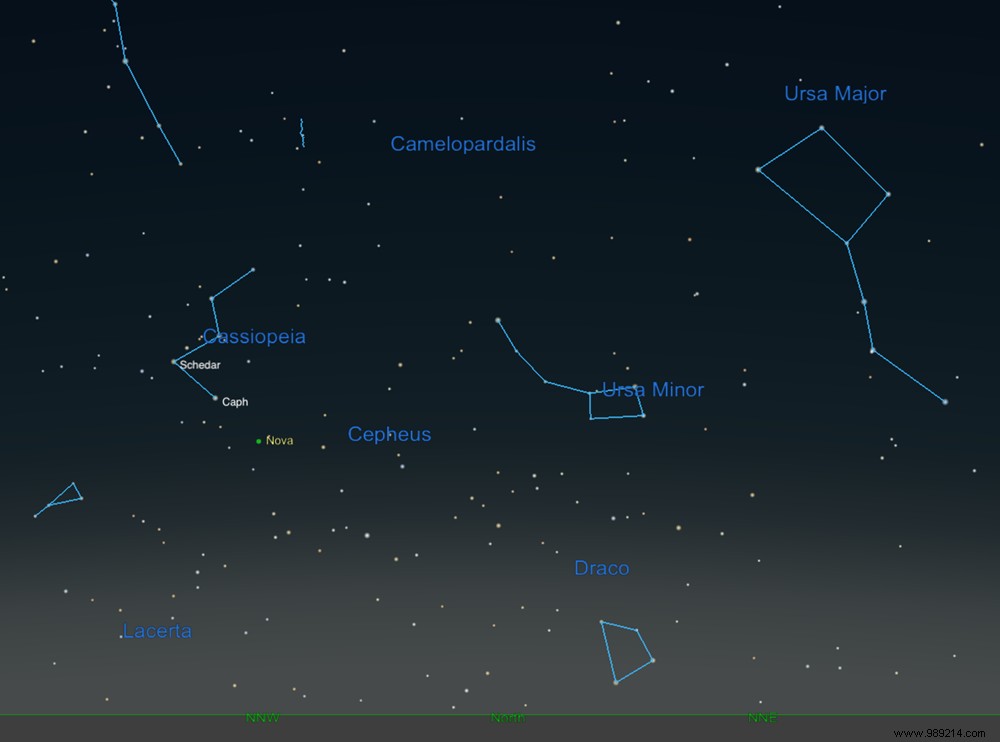
Northern Hemisphere skywatchers: Locate Cassiopeia's distinctive "W" high in the northwest after sunset. Use Schedar and Caph as guides; the nova sits about 5.9° northwest of Caph, as shown below.
Visibility may wane soon, so observe promptly with binoculars or a telescope for this rare celestial show.
