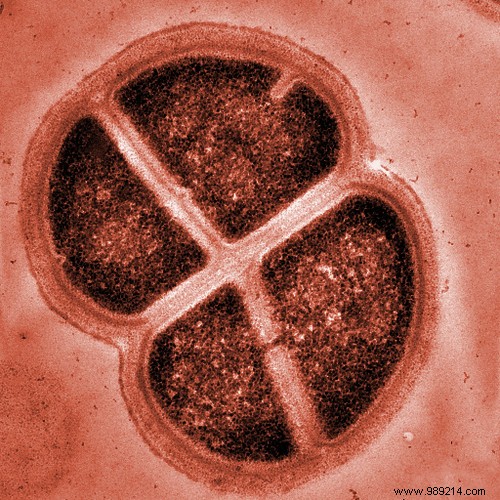
Named after the 1982 film Conan the Barbarian, Conan the Bacterium—scientifically known as Deinococcus radiodurans—ranks among the most radioresistant organisms on Earth. This extremophile withstands not just cosmic radiation but also vacuum, acids, UV rays, desiccation, starvation, and extreme temperatures.
Deinococcus radiodurans earned its nickname "Conan the Bacterium" for its extraordinary resilience. Discovered in 1956 by American researcher A.W. Anderson during gamma-ray sterilization of corned beef cans, surviving colonies stunned scientists. It's highly resistant to ionizing radiation and a true polyextremophile.
Since 1998, it's held a spot in the Guinness Book of Records as the toughest life form against radiation, enduring 1.5 million rads of gamma rays—3,000 times the lethal dose for humans. Decades later, it continues to captivate researchers.
Key studies from 2015–2018 aboard the International Space Station (ISS), via JAXA's ExHAM program, were detailed in Frontiers in Microbiology (August 2020). These revealed its survival mechanisms driving such durability.
Orbiting at 400 km, the ISS exposes experiments to an extreme environment: solar-facing surfaces hit 121°C, shadowed sides plunge to -157°C, plus relentless cosmic radiation. Researchers placed Deinococcus radiodurans aggregates on solar panels; after three years, all larger than 0.5 mm survived. Study leads estimated it could endure 15 to 45 years in space.
Its secret? Indefinite DNA repair, allowing revival hours after apparent death. This resilience hints at surviving Earth-to-Mars journeys and inspires ultra-durable data storage encoded in bacterial DNA, safe from disasters.
