Astronomers using NASA's TESS telescope have captured the first-ever observation of a white dwarf dramatically flickering on and off. The groundbreaking findings, led by experts from Durham University, are detailed in Nature.
White dwarfs represent the end stage for stars like our Sun after they exhaust their hydrogen fuel. These dense remnants are roughly the size of a small planet but pack the mass of a typical star.
Many white dwarfs exist in binary systems where, if orbits are tight (periods from tens of minutes to hours), they can accrete material from a companion star, causing sudden brightness spikes.
Typically, this accretion is stable, with major changes unfolding over days, weeks, or months. However, a Durham University team observed TW Pictoris—a white dwarf—fading and brightening by factors of up to 3.5 in just 30 minutes. This ultra-short timescale defies current models.
"To see TW Pictoris' luminosity plummet in thirty minutes is in itself extraordinary, as this has never been seen in other white dwarfs in accretion. This is totally unexpected based on our understanding of how these systems are supposed to feed," says lead author Dr. Simone Scaringi.
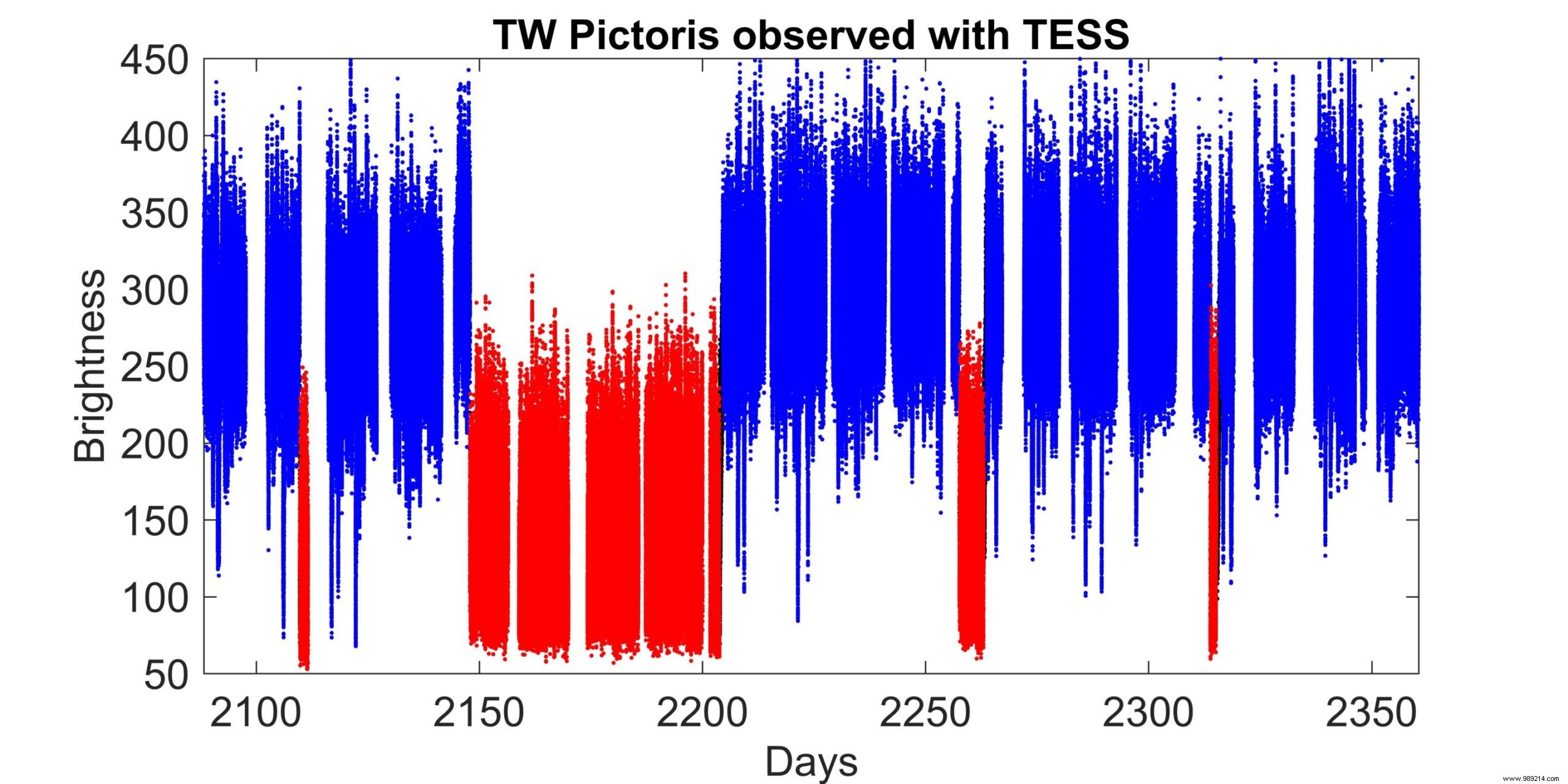
The discovery came from data collected by the Transiting Exoplanet Survey Satellite (TESS), primarily used for exoplanet hunts. TW Pictoris lies about 1,400 light-years from Earth and feeds on hydrogen and helium from its companion.
Under normal conditions, material flows steadily into the white dwarf's accretion disk without such rapid luminosity swings. This anomaly offers new insights into accretion physics.
The team suspects rapid reconfigurations of the white dwarf's surface magnetic field. Its swift rotation may create a centrifugal barrier, intermittently blocking fuel from the disk. Occasional breakthroughs through a narrow 'gate' cause the observed brightness pulses.
