Millions of years ago, a magnetar unleashed a colossal energy burst equivalent to a billion suns in mere fractions of a second. Last year, the ASIM instrument aboard the International Space Station captured this extraordinary event. Leading astronomers attribute these intense outbursts to 'starquakes' on the star's surface.
Neutron stars emerge from the gravitational collapse of a massive star's core at the end of its life cycle, following a supernova explosion. What remains is a compact object, nearly pure neutrons, with 1.3 to 2.5 solar masses (roughly 330,000 Earths) squeezed into a 20-kilometer-diameter sphere.
Magnetars represent a rare subset of neutron stars, boasting magnetic fields over 1,000 times stronger than typical counterparts.
These extraordinarily luminous objects—up to thousands of times brighter than the Sun—can erupt in sudden, brilliant flares. Yet these events are extremely brief and unpredictable, posing significant challenges for observation. Nonetheless, a recent breakthrough by astrophysicists has changed that.
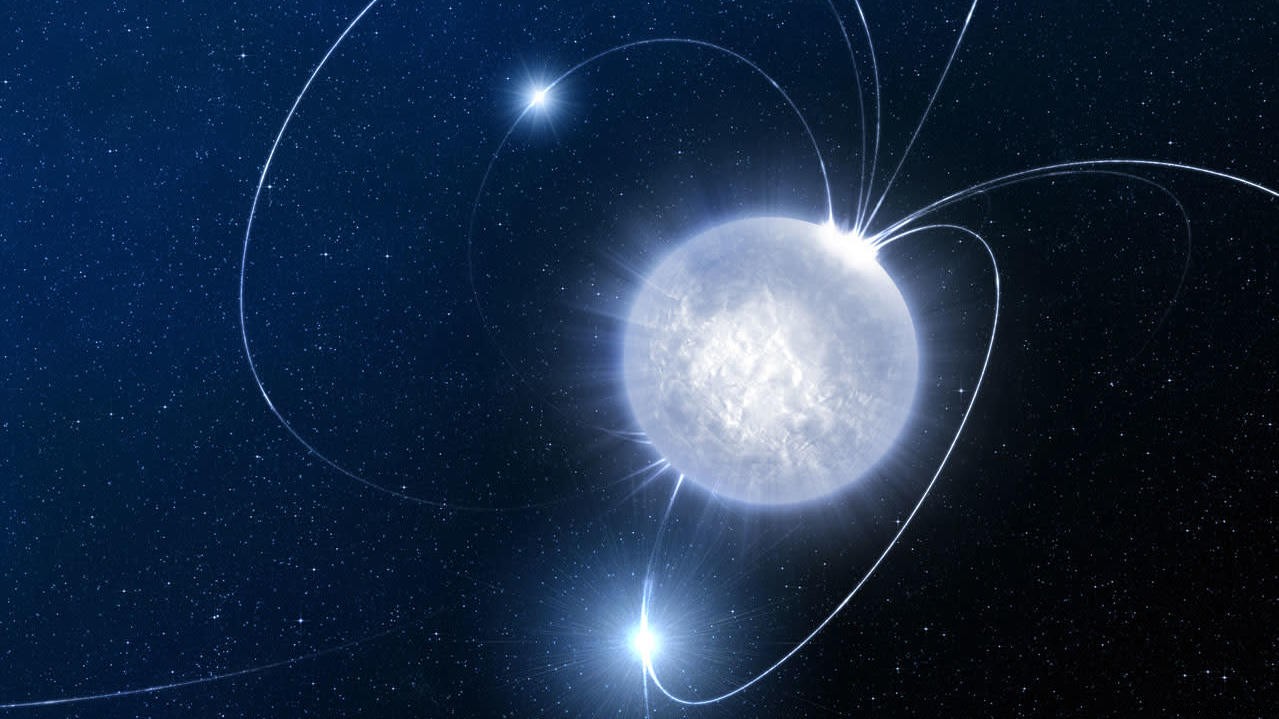
This magnetar resides in the Sculptor Galaxy, a spiral galaxy approximately 13 million light-years from Earth. The flare was detected on April 15, 2020, by the Atmosphere-Space Interactions Monitor (ASIM) on the ISS.
Analysis reveals the star released energy equivalent to 100,000 years of our Sun's output—in just 0.16 seconds, vanishing as abruptly as it appeared.
"It's as if this magnetar, from its cosmic isolation, screamed into the void with the force of a billion suns," says Alberto J. Castro-Tirado of Spain's Institute of Astrophysics of Andalusia.
Published in Nature, the study details over a year's analysis of ASIM data, identifying four phases tied to the magnetar's energy output and magnetic field shifts.
This discovery is pivotal: only about 30 magnetars are known among 3,000 neutron stars, and this is the farthest flare observed. Experts propose 'starquakes'—seismic disruptions in the magnetar's elastic crust—as the trigger.
