In October 1995, astrophysicists at the Observatoire de Haute-Provence identified the first exoplanet orbiting a Sun-like star: 51 Pegasi b. Today, over 4,500 exoplanets have been confirmed across nearly 3,400 planetary systems, with thousands more candidates awaiting verification. Several of these worlds are rocky like Earth and lie in the habitable zone, prompting experts to ask: Are we alone, or do intelligent species thrive elsewhere?
Humanity has gazed at the stars for millennia, yet the question of extraterrestrial life persists, fueling science fiction and public fascination. Surveys show most people believe in aliens; an Ipsos poll revealed 20% of the global population thinks extraterrestrials live among us, disguised as humans.
While the probability of life beyond Earth remains uncertain, mounting evidence from exoplanet discoveries boosts optimism. Life as we know it needs liquid water, so planets too close or too far from their stars are less promising.
Our strongest leads are planets in the habitable zone. To date, no compelling signs of advanced extraterrestrial technology have emerged from space telescopes or ground observatories—though Harvard's Avi Loeb argues otherwise regarding the interstellar object 'Oumuamua, which passed Earth in 2017. Nor have we spotted microbial life, partly due to lacking a universal definition of life, which might manifest in unforeseen forms. What are our prospects for detecting extraterrestrial intelligence (ETI)?
In 1961, astronomer Frank Drake, founder of the SETI Institute, devised an equation to estimate communicative civilizations in the Milky Way. It multiplies factors like stars forming annually, fraction with planets, habitable planets per system, and the duration civilizations broadcast radio signals. Using 1960s data, Drake estimated about 10 such societies.
Estimating these variables precisely is challenging, and consensus eludes experts. In 2013, MIT's Sara Seager refined the equation to six factors, targeting any life via detectable biosignatures, including from 'silent' stars and planets with gaseous life indicators.
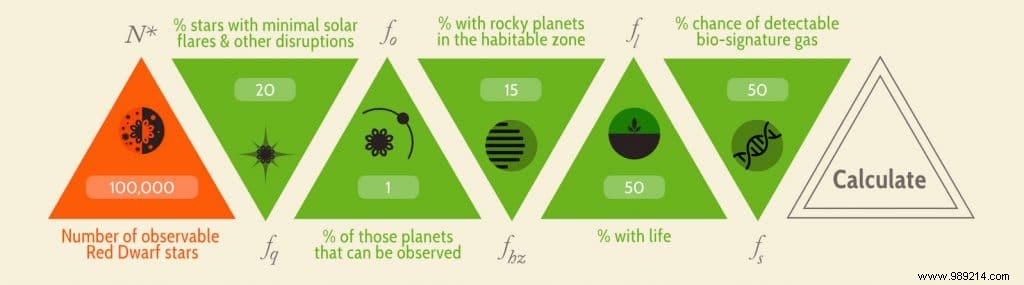
Applying her model to abundant M-dwarf (red dwarf) stars, Seager predicted we might detect biosignatures on two inhabited planets within a decade. That timeline nears its end, but the James Webb Space Telescope (JWST), launched December 22, 2021, offers hope. With 6% of red dwarfs hosting Earth-sized habitable-zone planets, JWST could reveal atmospheres rich in oxygen, CO2, methane—or even photosynthesis markers—signaling life, potentially animal or microbial.
Technologically advanced life might produce detectable pollution, much like Earth's. Powerful instruments could distinguish simple from intelligent biospheres.
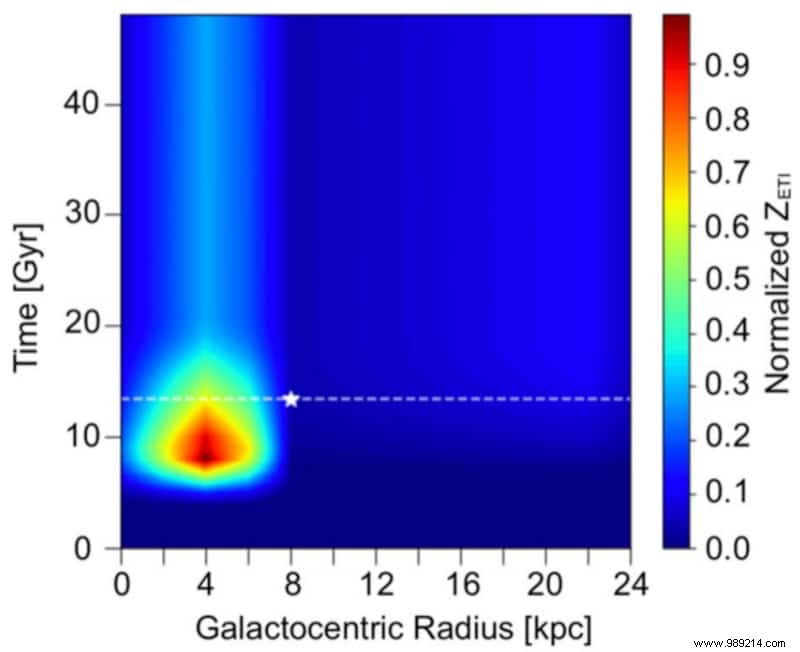
Caltech researchers recently quantified ETI prevalence in the Milky Way, publishing in Galaxies. They pinpointed peak life emergence 13,000 light-years from the galactic center, 8 billion years post-galaxy formation—conditions fading since. Earth sits 25,000 light-years out, with civilization arising 13.5 billion years after the Milky Way's birth. "Our results may imply that intelligent life may be common in the galaxy, but is still young […] [They] also suggest that our location on Earth is not in the region where most intelligent life resides, and that SETI practices need to be closer to the inner galaxy, preferably in the ring at 13,000 light years from the galactic center," the team notes. Self-destruction via technology emerges as the key limiter.
Microbial life odds surpass ETI; recent finds of 'hycean' worlds—2.5x Earth's size, ocean-covered under hydrogen atmospheres—could teem with extremophile-like microbes, abundant galaxy-wide.
As contact odds seem slim, preparing public communication is vital. Optimists envision utopian ETIs solving Earth's woes; microbial finds might disappoint. A NASA team, publishing in Nature, urges a confidence scale for astrobiology results. "Our generation could realistically be the ones to discover evidence of life beyond Earth," they write, led by chief scientist Jim Green.
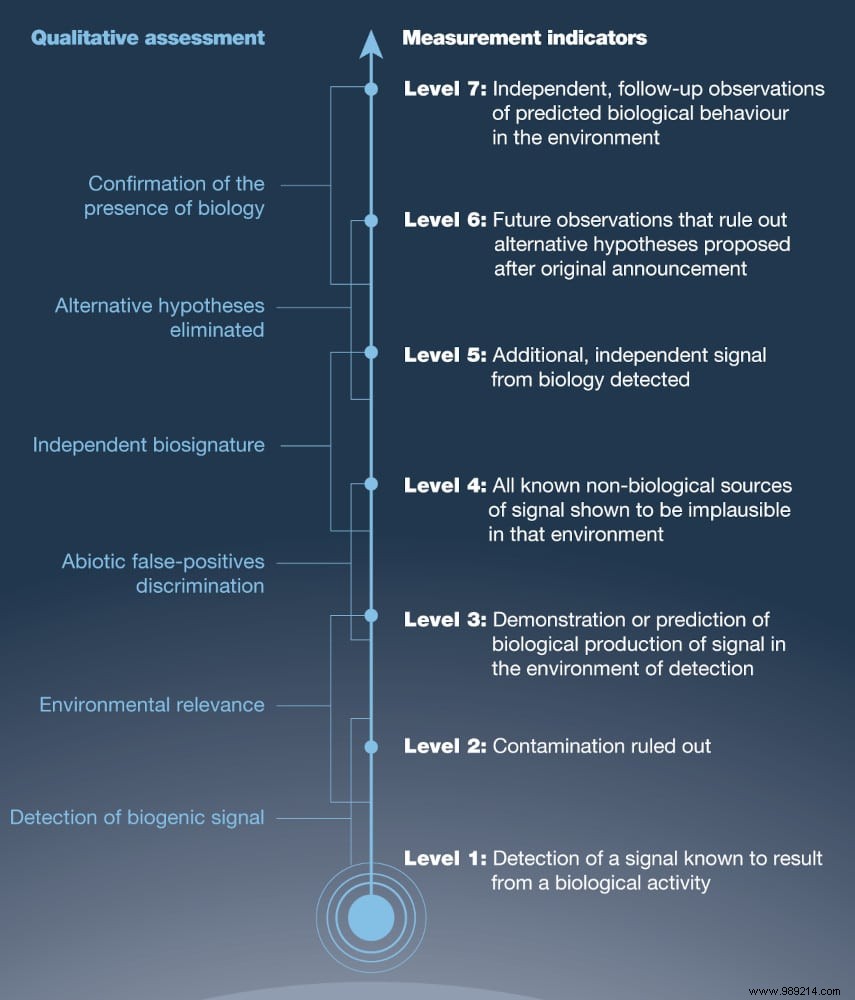
"We need a better way to share the excitement of our discoveries and demonstrate how each discovery builds on the next, so we can bring the public and other scientists on the journey," says co-author Mary Voytek, NASA Astrobiology Program Manager.
Level 7 denotes certainty of life detection. NASA's Ravi Kopparapu is unequivocal: "It's not a question of 'if', it's a question of 'when' we will find life on other planets. I am sure that in my lifetime, in our lifetime, we will know if there is life on other worlds."
