As the James Webb Space Telescope begins its mission 1.5 million kilometers from Earth, age-old questions about the cosmos persist: How did galaxies form? Since discovering the universe's expansion in the 1920s, how do we measure it, and what does it tell us about the universe's size? Is it truly infinite, or finite yet unbounded? Scientists continue to debate these profound ideas.
Emerging from the Big Bang about 13.8 billion years ago, the universe encompasses all space, time, energy, and matter. Picturing it with edges like a physical object is challenging—any boundary would imply something beyond, which contradicts its definition. Yet, it could be finite, curving back on itself without borders.
Whether finite or infinite, we can't see it all. Its finite age limits us to the observable universe—a portion where light has reached us. This likely represents just 2% of the whole, given light's constant speed. Events appear delayed by travel time.
Even within the observable universe, pre-Big Bang events are beyond reach. Its boundary, the cosmological horizon, marks where light from 13.8 billion years ago arrives, hiding anything farther.
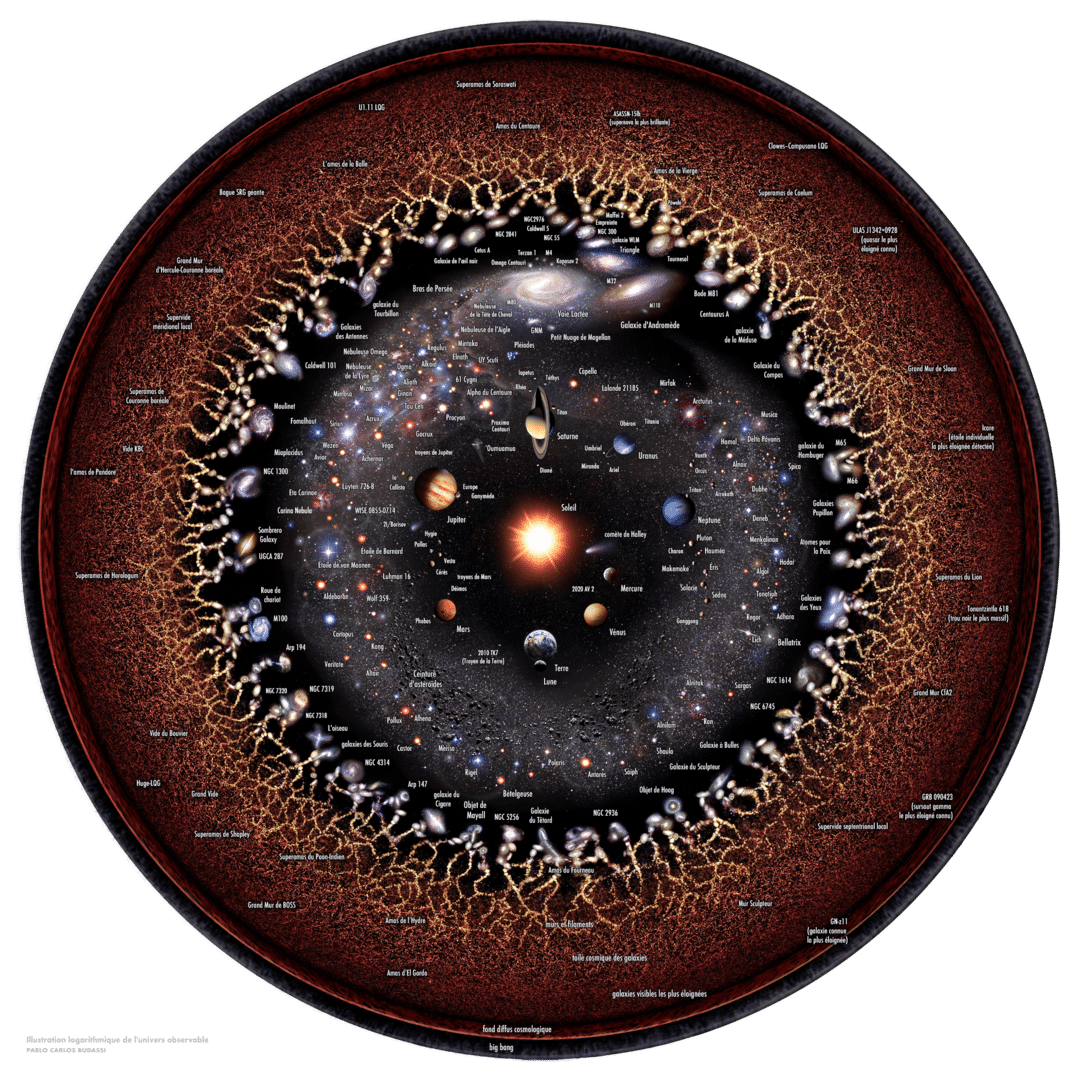
Astrophysicists estimate the observable universe's diameter at 100 billion light-years, home to roughly 100 billion galaxies organized into clusters and superclusters. While vast, it's expanding, potentially revealing more galaxies over time—not conclusive proof of finitude.
Two main ideas persist: a finite, borderless space or an infinite one. The infinite model posits endless expansion since the Big Bang. As NASA explains: "The fate of the universe is determined by a struggle between the momentum of expansion and the force of gravity." The expansion rate is the Hubble constant; gravity depends on matter density and pressure. Below critical density, expansion continues forever; above, gravity wins, leading to collapse.
Recent data show accelerating expansion, not constant speed. Julien Grain, researcher at the Institut d'Astrophysique Spatiale d'Orsay, told France Culture: "The universe's expansion varies historically, driven by matter density. We measure this to reconstruct its past, revealing early deceleration phases."
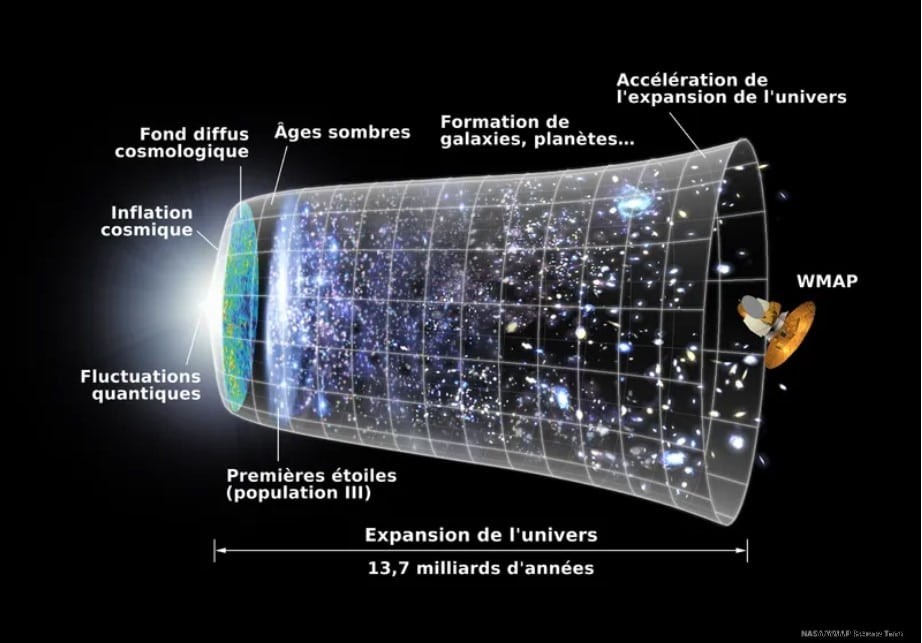
Shape depends on density: above critical, positively curved and spherical (finite); below, negatively curved and open (infinite); equal, flat and infinite. NASA's inflationary theory predicts near-critical density and flat geometry. WMAP data refined this to 0.4% error margin, supporting a flat, infinite universe.
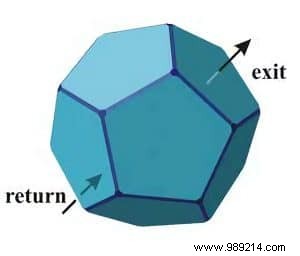
Contrasting studies exist. Astrophysicist Jean-Pierre Luminet proposes a Poincaré dodecahedral space—a finite, edgeless cosmos. He likens it to a soccer ball's interior: "Nature uses the image of a soccer ball... You emerge opposite after hitting a pentagonal wall, allowing endless travel in finite space." This retains the Big Bang but favors spherical geometry over flat infinity.
A 2019 Nature study reanalyzing Planck data suggests positive curvature at 99% probability, though tiny. Researchers warn: "Assuming flatness may mask inconsistencies in cosmic properties." Future observations will distinguish systematics, new physics, or fluctuations.
Stephen Hawking and James Hartle favor closed universes as more natural. No consensus exists—true infinity remains unobservable, beyond any telescope's reach.
