In just a few days, skywatchers worldwide will witness a stunning cosmic event: a total lunar eclipse. With the Sun, Earth, and Moon perfectly aligned, the Moon takes on a dramatic reddish hue, earning it the nickname "Blood Moon." But what causes this captivating glow?
The year's only total lunar eclipse graces the skies this Wednesday, May 26, as the full Moon—a supermoon due to its close approach to Earth—passes through Earth's shadow. During this "Blood Supermoon," the Moon's face adopts a striking brick-red tone. This vivid glow defines the total lunar eclipse, the most striking of the three types (partial and penumbral being the others).
Total lunar eclipses happen only when the Sun, Earth, and Moon align precisely. As the Moon enters the darkest core of Earth's shadow (the umbra), you might expect it to vanish into darkness. Instead, it glows—but why?
Picture standing on the Moon's surface during the eclipse, gazing at Earth positioned squarely between you and the Sun. You'd see a brilliant, fiery ring encircling our planet—sunlight bending around Earth's edges.
Though Earth is far smaller than the Sun, this curved sunlight reaches the Moon after filtering through Earth's atmosphere. The air scatters shorter blue wavelengths, letting longer reds and oranges dominate, bathing the Moon in that iconic ruddy light.
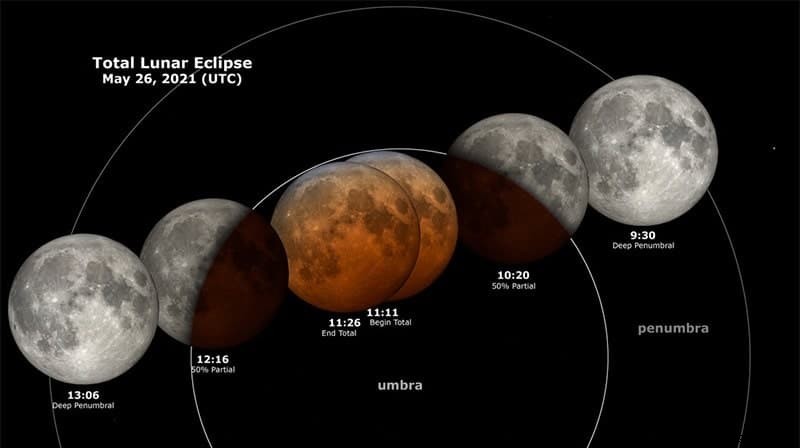
Not every eclipse fully engulfs the Moon. In partial eclipses, imperfect alignment means Earth's shadow covers only part of the lunar surface. Penumbral eclipses, the subtlest type, occur when the Moon passes through Earth's faint outer shadow (penumbra), often going unnoticed by casual observers.
This Wednesday's total lunar eclipse will be visible across Australia, parts of western United States, western South America, and Southeast Asia. Much of the world, including the entire United States, can catch at least partial or penumbral phases.
Looking ahead, the next penumbral eclipses are set for May 5-6, 2023; March 24-25, 2024; and February 20-21, 2027. The next total lunar eclipse, visible across parts of Asia, Australia, much of North America, South America, the Atlantic, Indian and Pacific Oceans, and Antarctica, occurs on May 16, 2022.
