Astronomers have announced the first direct detection of a magnetic field surrounding an exoplanet. Much like Earth's magnetosphere, which shields our planet from harmful solar particles, this field may protect distant worlds from stellar radiation.
HAT-P-11b, a Neptune-sized exoplanet located 123 light-years from Earth, was observed using the Hubble Space Telescope to study its ultraviolet interactions with its host star.
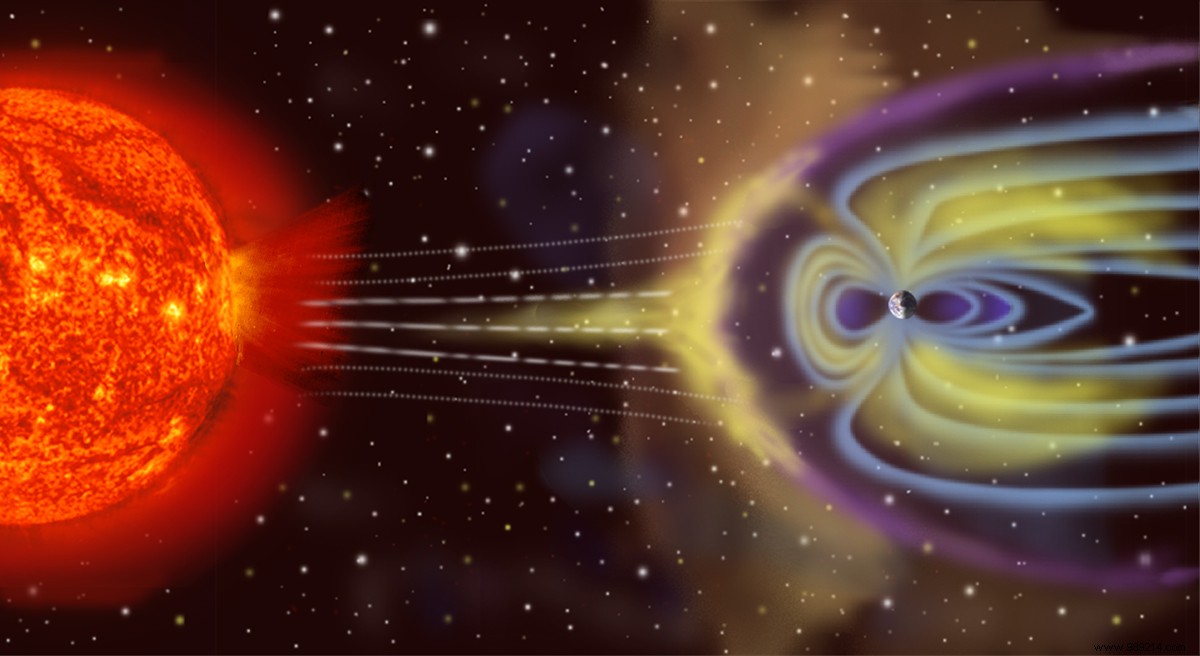
Data from six transits—when the planet passes in front of its star—revealed carbon ions, charged particles trapped by the planet's magnetic field, extending in a long tail away from the star. This mirrors Earth's magnetosphere, where solar wind distorts the field into a comet-like shape.
These Hubble observations mark the first identification of a magnetic field signature on an exoplanet outside our Solar System, with full details published in Nature Astronomy.
Earth's magnetosphere is vital for life, blocking excessive solar wind and preserving our atmosphere. Detecting such fields on exoplanets represents a crucial step in assessing planetary habitability. Notably, not all planets and moons in our Solar System generate magnetic fields, and their exact role in habitability remains under investigation.
The study also revealed that HAT-P-11b's atmosphere has a lower metallicity (abundance of elements heavier than hydrogen and helium) than predicted. In our Solar System, metal-rich ice giants like Neptune and Uranus have weak fields, while low-metallicity gas giants Jupiter and Saturn boast strong ones. This finding challenges existing models of exoplanet formation.
