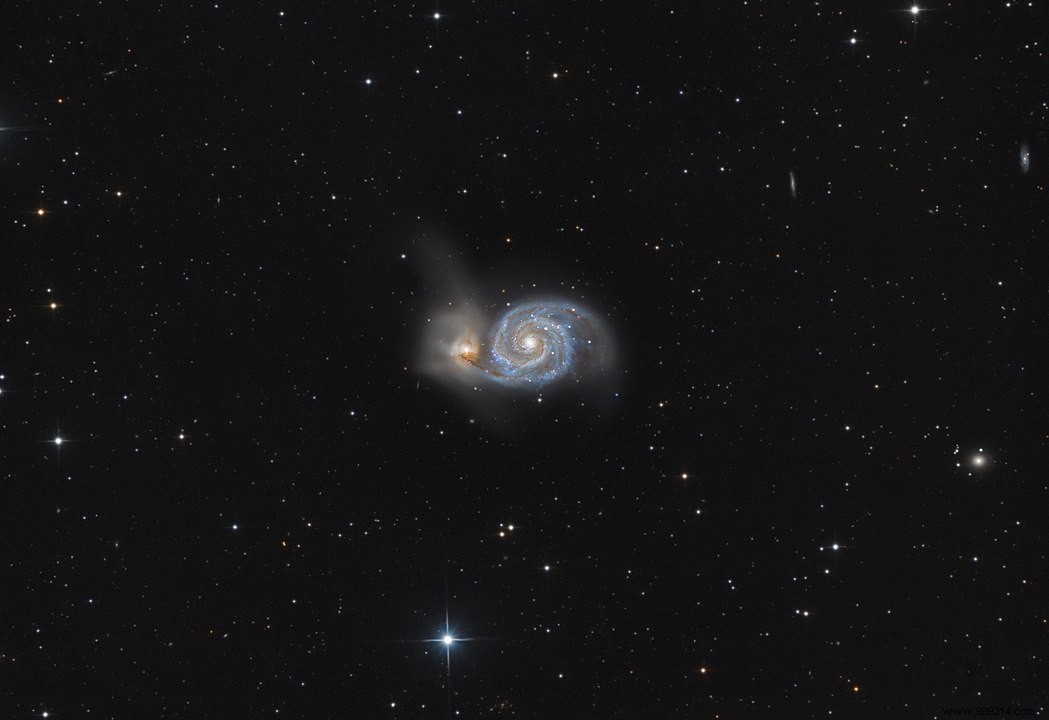
A team of astronomers from the Harvard-Smithsonian Center for Astrophysics has identified the first candidate exoplanet outside our galaxy. This unconfirmed world orbits in a binary system approximately 23 million light-years from Earth in the Whirlpool Galaxy (M51).
Since the groundbreaking discovery of the first exoplanet in 1995 by Michel Mayor and Didier Queloz at the Geneva Observatory, astronomers have confirmed more than 4,200 exoplanets, all within the Milky Way. Estimates suggest our galaxy alone hosts more planets than stars, hinting at their abundance across the universe.
Detecting exoplanets in distant galaxies poses immense challenges due to vast distances, but indirect methods offer hope. Recent analysis points to one such discovery.
Led by Rosanne Di Stefano, the team pinpointed a candidate in M51, located 23 million light-years away in the constellation Canes Venatici.
Dubbed M51-ULS-1b, this potential exoplanet resides in a binary system where a neutron star or black hole accretes material from a nearby massive star.
This process generates intense X-ray emissions as infalling gas heats up through friction, making the system one of the brightest X-ray sources in M51.
The compact X-ray source implies that a Saturn-sized planet at about a billion kilometers could fully eclipse it from our view during transit.
On September 20, 2012, the Chandra X-ray Observatory captured exactly that: a three-hour dimming of the source, which faded and rebrightened. Previously overlooked, as Chandra data typically isn't scrutinized for such brief variations.
Alternatives like a white dwarf eclipse are unlikely, as Di Stefano notes the system is too young for such an evolved companion.
A temporary halt in accretion wouldn't match the observed uniform fading and reappearance across all light frequencies, unlike expected spectral changes.
Thus, a transiting exoplanet remains the most plausible explanation. Confirmation will be the next challenge.
Di Stefano's team anticipates more discoveries, having analyzed only a fraction of Chandra's archives—enough for over ten similar surveys, potentially yielding a dozen additional candidates in wide orbits.
