Astronomers from the Center for Astrophysics | Harvard & Smithsonian announce a groundbreaking potential discovery: the first planet outside our Milky Way galaxy. This candidate world orbits in a binary system 27 million light-years away in the spiral galaxy Messier 51 (M51), the iconic Whirlpool Galaxy.
Since the first exoplanet confirmation in 1995, scientists have cataloged over 4,500 worlds orbiting stars in our Milky Way—some nearby within light-years, others thousands of light-years distant and beyond direct reach. But could planets exist beyond our galaxy? A compelling new study published in Nature Astronomy suggests yes.
The candidate planet resides in Messier 51 (M51), the Whirlpool Galaxy, renowned for its striking spiral arms and located in the constellation Canes Venatici, 27 million light-years from Earth.
Lead researcher Rosanne Di Stefano from the Center for Astrophysics | Harvard & Smithsonian in Cambridge, Massachusetts, applied the transit method—detecting periodic dips in a star's brightness as a planet passes in front. Unlike optical surveys from telescopes like Kepler or TESS, which chase faint light dips, Di Stefano analyzed X-ray brightness drops from NASA's Chandra X-ray Observatory in bright X-ray binaries.
These systems feature a neutron star or black hole accreting gas from a companion star, heating it to emit intense X-rays. The compact X-ray emitting region allows a transiting planet to fully eclipse the signal, enabling detection at vast distances unattainable with optical methods where planets are lost in stellar glare.
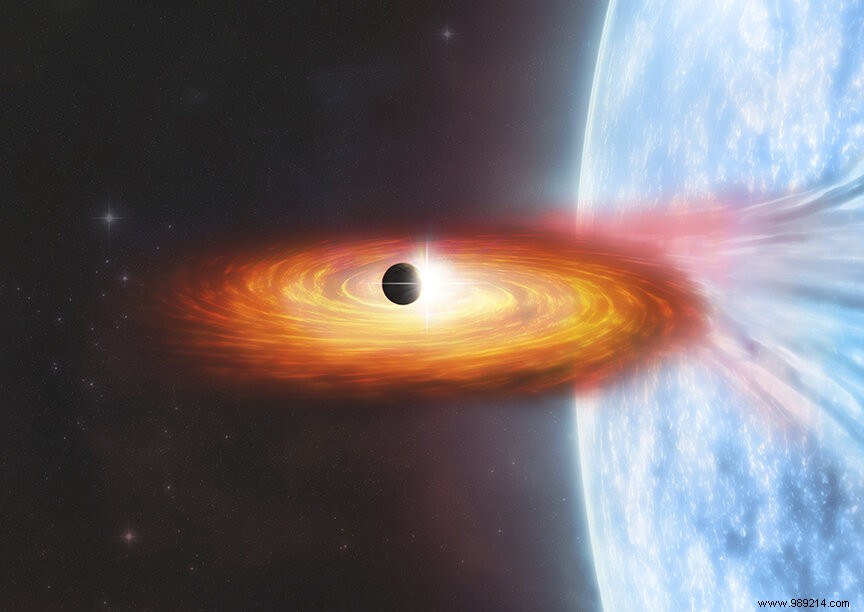
The study targets the binary system M51-ULS-1, likely hosting a black hole or neutron star paired with a companion roughly twenty times the Sun's mass. The detected X-ray transit lasted about three hours, fully blocking emissions.
Analysis indicates a Saturn-sized planet orbiting at nearly three billion kilometers from the compact object.
While a passing gas or dust cloud could mimic this, the event's profile doesn't match, making a planetary transit the leading explanation.
Confirmation requires further study, but the next transit won't occur for about 70 years, delaying verification for decades.
