By colliding lead ions at over 99.9% the speed of light, physicists at CERN recreated and studied the universe's primordial matter, formed moments after the Big Bang. This substance showed less resistance to flow than any known material.
The Big Bang marked the birth of space and time. Astronomers concur that within a second, the cosmos underwent inflation, expanding by at least 10^52 times in an instant. Once inflation ended, the energy driving it decayed, filling the universe with matter and radiation.
Prior to this expansion, cosmologists envision the universe as an ultra-hot soup—over a quadrillion degrees—comprising quarks, fundamental particles, and gluons, which mediate the strong force binding quarks.
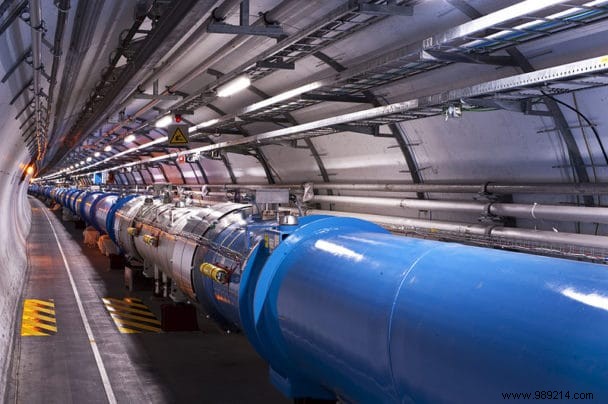
At CERN in Switzerland, researchers used the Large Hadron Collider (LHC) to mimic this primordial "stew." The LHC smashes particles near light speed to probe Big Bang conditions and matter's behavior under extreme energies.
You Zhou and colleagues from the Niels Bohr Institute at the University of Copenhagen collided heavy atomic nuclei, creating a fleeting fireball that deconstructed particles into their basic components. This produced quark-gluon plasma (QGP), the universe's earliest matter form.
Existing for just 10^{-23} seconds, the QGP was analyzed via advanced computer simulations. Results revealed it as a perfect fluid with near-zero viscosity and exceptional flow properties, unlike any other matter.
These findings illuminate the early universe. "Our results reveal how plasma evolved post-Big Bang," says lead author You Zhou. "This detail edges us closer to unraveling the Big Bang and the universe's growth in its first microsecond."
