Among the planets orbiting our Sun, Neptune stands as the farthest and most serene in appearance. This ice giant owes its captivating bluish tint to its atmosphere—but what exactly causes this distinctive color?
Orbiting approximately 4.5 billion kilometers from the Sun, Neptune is invisible to the naked eye. It was discovered in 1846 through meticulous calculations: French astronomer Alexis Bouvard noted gravitational anomalies in Uranus's orbit, leading Johann Galle to spot the planet. Urbain Le Verrier's independent predictions further confirmed its location.
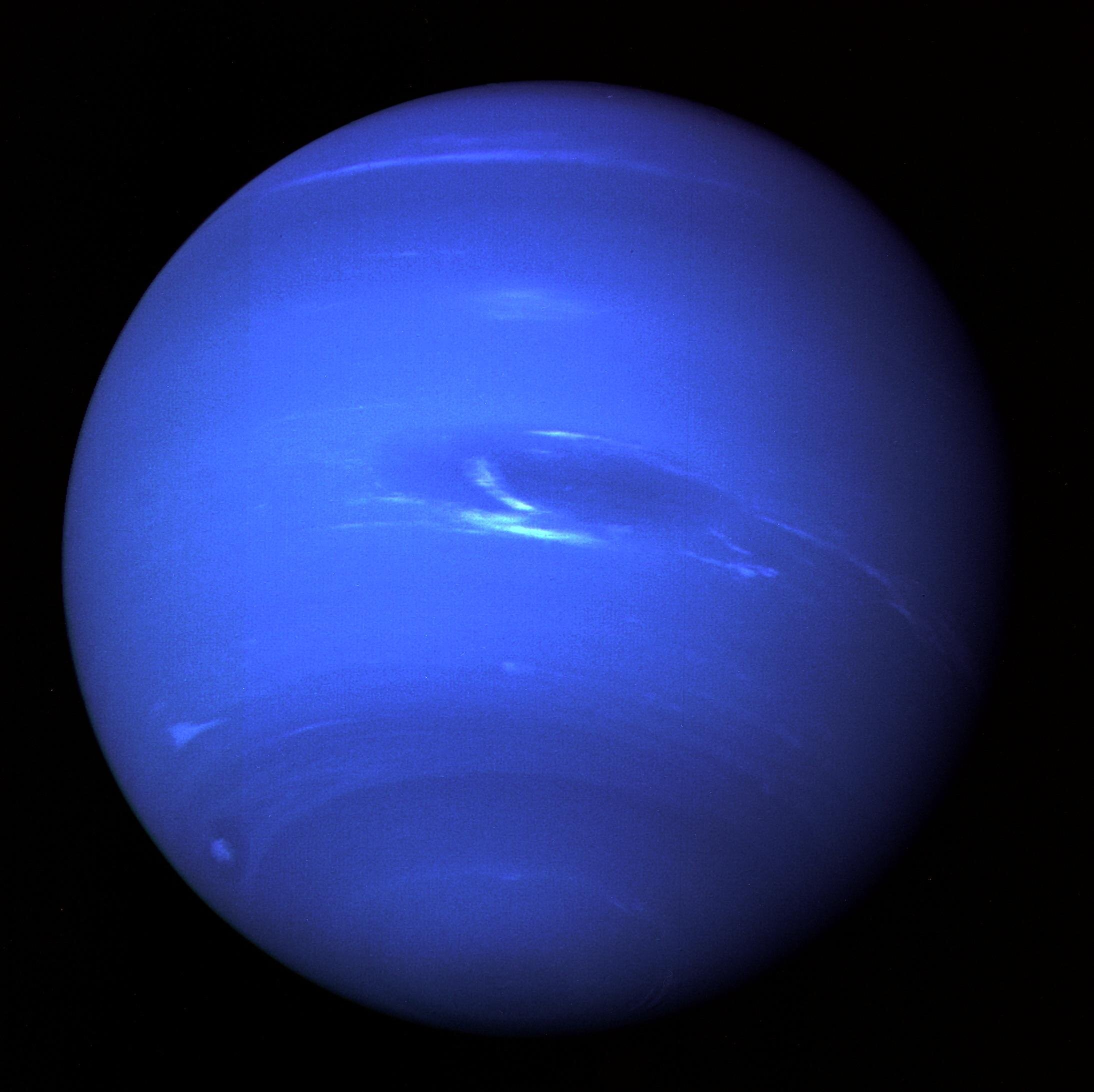
No one knew Neptune's appearance until NASA's Voyager 2 flew by in 1989, the only spacecraft to visit it. Now venturing through interstellar space, Voyager 2 revealed Neptune's vivid oceanic blue. Through telescopes, this eighth planet gleams in shades of azure. The planet is 58 times larger than Earth and about 17 times more massive.
Neptune's atmosphere consists mainly of hydrogen (80%), helium (19%), and methane (1%). Like Earth's, its clouds shift with altitude. At such extreme distances—over 4.5 billion kilometers from the Sun—freezing temperatures cause methane to condense in the upper atmosphere.
Though scarce, methane absorbs red light wavelengths above 600 nm, scattering shorter blue wavelengths and imparting a cooler tone. This makes methane the dominant factor in Neptune's signature color.
Yet methane alone doesn't fully explain it. Uranus has a similar atmospheric composition but appears greener, like aquamarine. Unidentified chemical species in Neptune's atmosphere likely enhance its pure blue hue, a mystery scientists continue to investigate.
NASA has proposed an orbiter and atmospheric probe to Neptune and Uranus by 2030. These missions aim to unravel the formation of these ice giants, shedding light on the many Neptune-sized exoplanets discovered so far.
These remain concepts for now. Separately, a Triton mission—Neptune's largest moon—is under consideration. If approved next year, it could launch in October 2025 and arrive in 2038.
