Astronomers expect a supermassive black hole equivalent to several billion suns at the heart of galaxy Abell 2261. Yet, no evidence of it has been found. Is it dormant? Ejected? The search continues with leading experts.
Astronomers have long known that supermassive black holes lurk at the centers of massive galaxies. These cosmic giants can weigh millions to billions of times the Sun's mass, scaling with their host galaxy's size.
In 2012, a team using NASA's Hubble Space Telescope was stunned to find no trace of one in the colossal galaxy Abell 2261, located about 2.7 billion light-years away in the constellation Hercules, near Vega.
Given its scale, theory predicts a central behemoth of at least ten billion solar masses—far surpassing the Milky Way's 4-million-solar-mass black hole.
Marc Postman from the Space Telescope Science Institute and Tod Lauer from the National Optical-Infrared Astronomy Research Laboratory in Tucson, Arizona—the original discoverers—have since probed the core for X-rays or radio emissions. So far, nothing.
Where is this black hole? "It's an intriguing mystery, but we're on the case," says Dr. Postman.
Black holes are invisible, but the X-rays and radio waves from infalling matter reveal them across the cosmos.
In 1980, astronomers Mitchell Begelman, Martin Rees, and Roger Blandford described how merging black holes from galaxy collisions form binary systems. These interact with surrounding stars, flinging them out over time.
This "scouring" disperses starlight, creating a diffuse core with a faint central cusp housing the black hole pair.
Drs. Lauer and Postman suspected a scoured core in Abell 2261, but found a void instead—no cusp, as if the black hole(s) had vanished.
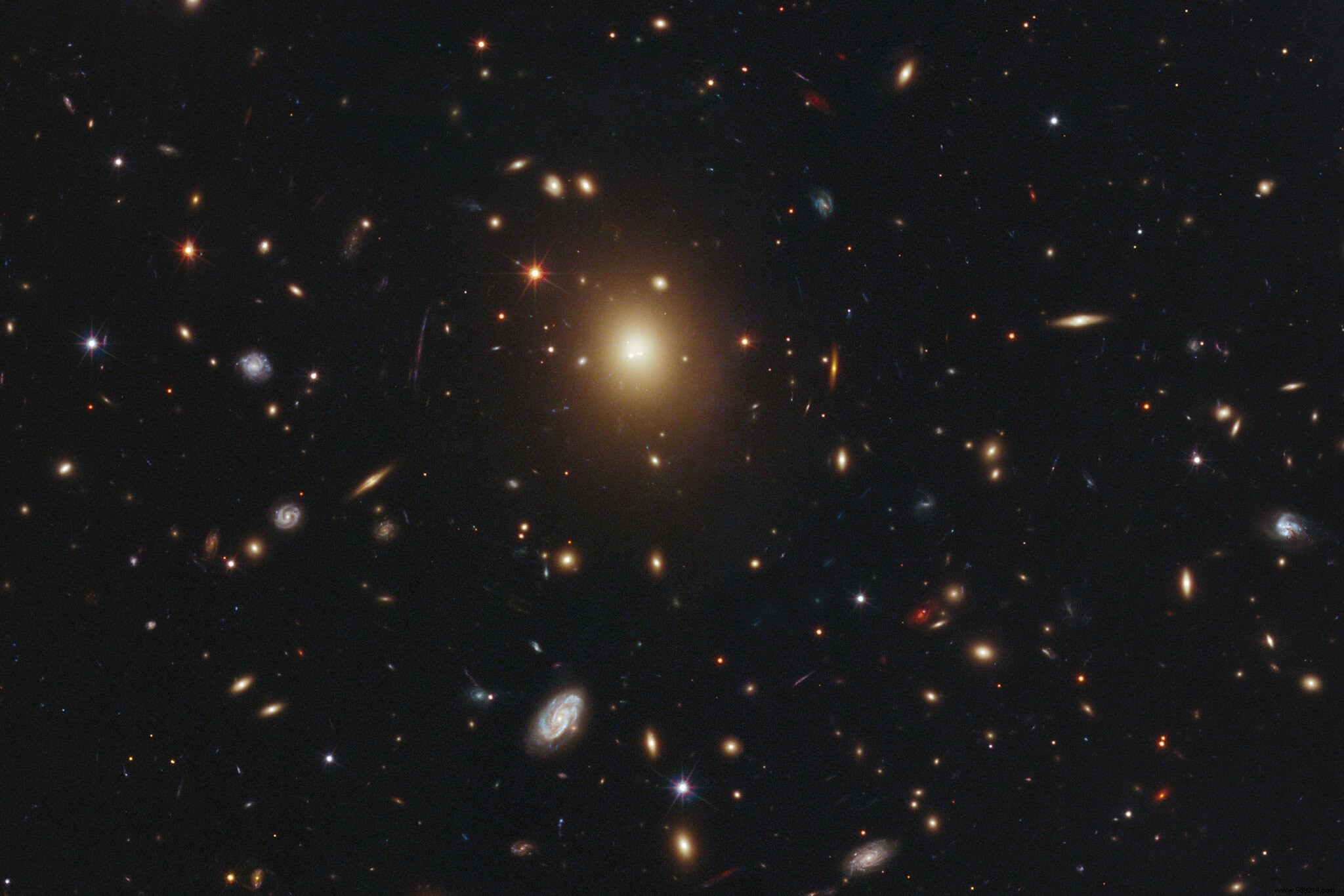
One theory: During merger, asymmetric gravitational wave emission recoiled the black hole outward. Models support such ejections, but it should remain near the center.
Deeper imaging revealed four compact "light knots" in the core. Could one hide the black hole?
Led by Sarah Burke-Spolaor of West Virginia University, Hubble spectroscopy measured stellar velocities in these knots to detect massive companions.
Two proved remnants of devoured satellite galaxies. The third's data was inconclusive due to large errors. The fourth, faint and compact near the core's edge, evaded clear analysis.
Eyes now turn to the James Webb Space Telescope, launching late October. Its superior infrared sensitivity could unmask the culprit in these knots.
