Astronomers at the University of Texas have identified a supermassive black hole at the core of Leo I, a dwarf satellite galaxy of the Milky Way. This black hole rivals the mass of our galaxy's central one. Findings are detailed in The Astrophysical Journal.
Discovered in 1950 by R. G. Harrington and A. G. Wilson, Leo I is a dwarf spheroidal galaxy in the Local Group, located about 800,000 light-years from the solar system. Unlike typical Milky Way satellites, it harbors minimal dark matter, making it a compelling subject for research.
In this study, researchers measured stellar motions to map dark matter density from the galaxy's outskirts to its center. Faster stellar speeds indicate higher dark matter concentrations.
Using the VIRUS-W instrument on the Harlan J. Smith Telescope at McDonald Observatory, the team gathered data, which was analyzed via supercomputer at the Texas Advanced Computing Center (TACC) at UT Austin. The results were astonishing.
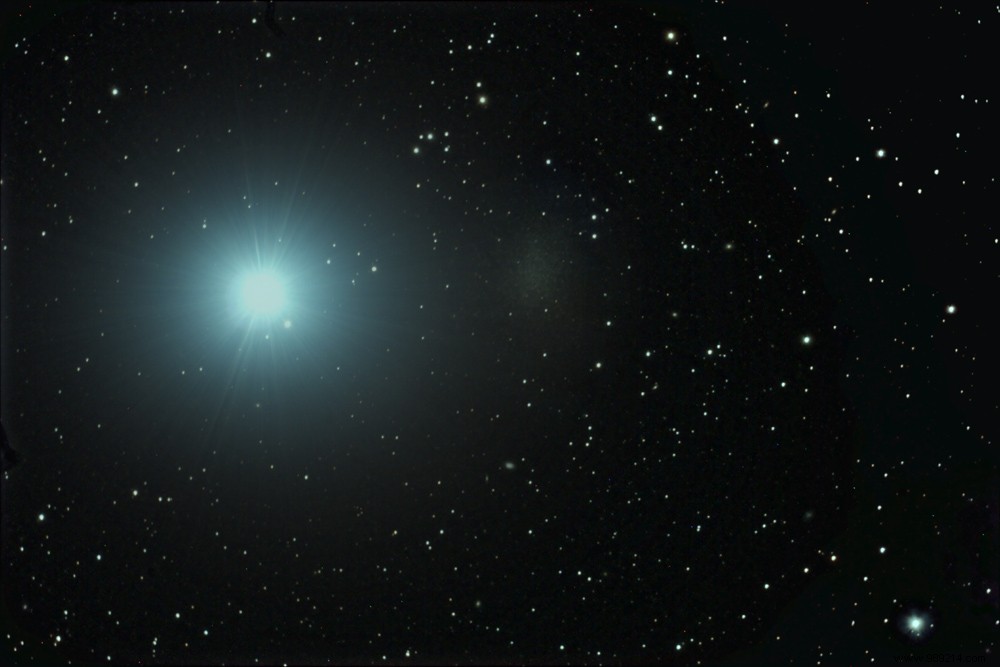
The stellar dynamics reveal a supermassive black hole whose mass—estimated at roughly four million solar masses—matches that at the Milky Way's center.
This mass ratio is unprecedented for a dwarf galaxy like Leo I. Previously, such massive black holes were not expected in these small systems, upending models of galaxy formation and evolution.
"If the Leo I black hole's mass is confirmed at this level, it could reveal how black holes grow in massive galaxies," says Karl Gebhardt of the Max Planck Institute for Extraterrestrial Physics (MPE).
One scenario: As dwarf galaxies like Leo I merge into larger ones, their black holes combine, fueling the growth of supermassive black holes in giants like the Milky Way.
