Seven billion years ago, two massive black holes collided to form a single intermediate-mass black hole—a rare and elusive class of cosmic object.
LIGO in the U.S. and Virgo in Italy are the world's premier gravitational wave observatories. They made history in September 2015 by detecting the first spacetime ripples from two black holes merging 1.3 billion light-years away. Since then, they've captured numerous events involving black holes and neutron stars.
Today, an international team announced the most massive black hole merger yet via gravitational waves: two objects of 66 and 85 solar masses fused into one weighing 142 solar masses (accounting for mass lost during the collision).
This epic event occurred about seven billion light-years from Earth—half the universe's age—with the waves traveling across cosmic distances to reach our detectors.
Remarkably, the resulting black hole belongs to the intermediate-mass category.
Black holes span a spectrum: stellar-mass ones (under 100 solar masses) from collapsed stars, and supermassive giants (millions or billions of solar masses). Intermediate-mass black holes fill the gap but are notoriously hard to spot.
Detection often requires a star venturing too close, triggering X-ray emissions. NASA's Hubble has recently confirmed one such object. This LIGO-Virgo find solidifies their existence through direct gravitational evidence.
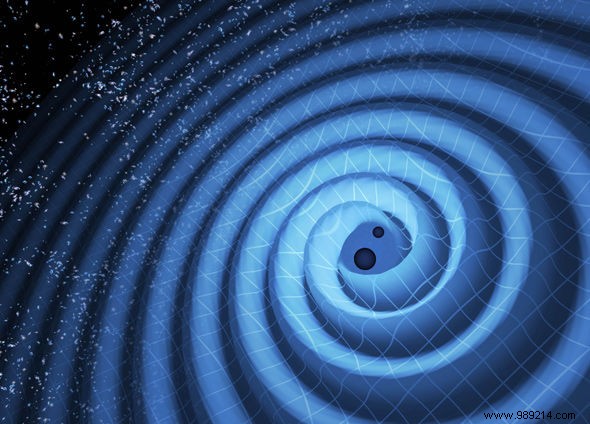
The larger progenitor black hole, at 85 solar masses, defies stellar evolution models, landing squarely in the "pair instability" gap.
"Based on our understanding of stellar evolution, we expect black holes below 65 solar masses or above 135, but nothing in between," says Frank Ohme of the Max Planck Institute for Gravitational Physics (AEI) in Hannover.
To explain this 85-solar-mass outlier, researchers propose it formed from prior mergers of smaller black holes or unusually massive stars.
Findings appear in Physical Review Letters and The Astrophysical Journal Letters. During their third observing run (April 2019–March 2020), LIGO and Virgo identified 56 candidate events; 52 more await analysis.
