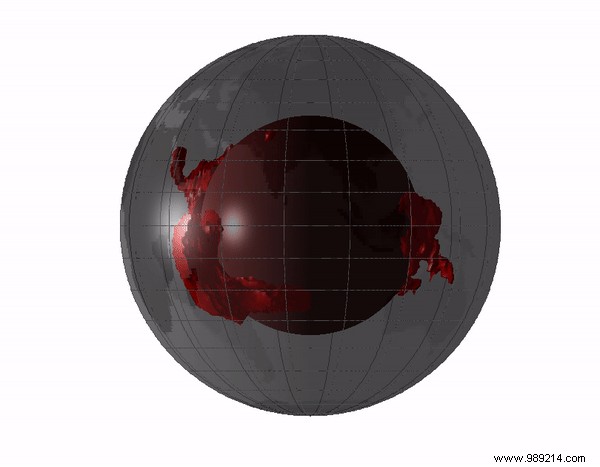
Deep within Earth's mantle lie two colossal structures known as Large Low Shear Velocity Provinces (LLSVPs)—among the planet's most mysterious features. Cutting-edge simulations now suggest they may be remnants of Theia, the protoplanet behind the Moon's formation.
These massive "blobs" of dense rock reside at the base of Earth's mantle, near the core-mantle boundary. As their name implies, LLSVPs exhibit unusually slow shear wave velocities—seismic waves that propagate through solid materials.
One sprawls beneath Africa, the other under the Pacific Ocean. Each spans thousands of kilometers laterally and rises hundreds of kilometers vertically, so immense they influence global seismic patterns.
Their origins remain debated. Some scientists propose they're "graveyards" of ancient subducted oceanic slabs. Others argue they're far older—and potentially extraterrestrial.
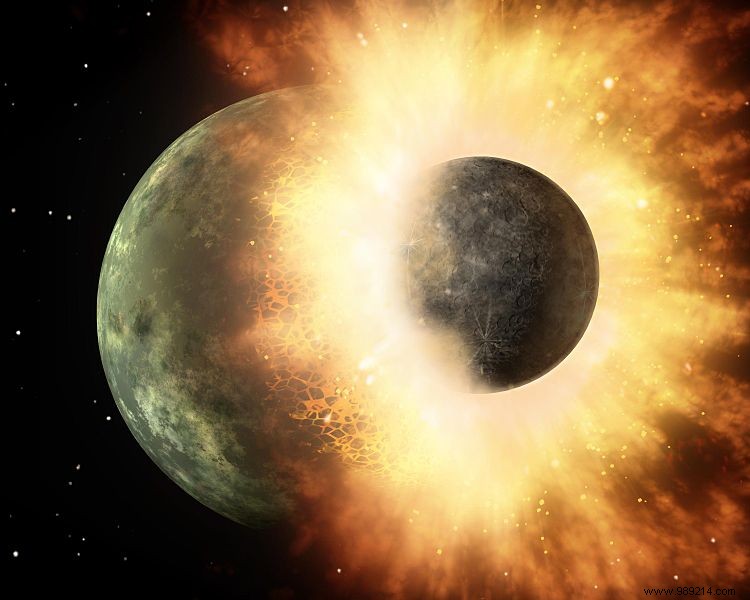
The leading theory holds that 4.5 billion years ago, a Mars-sized body called Theia slammed into the young Earth. The colossal impact ejected debris that coalesced into the Moon.
What became of Theia itself? Recent models from Arizona State University researchers propose its mantle remnants sank deep into Earth's interior, piling up as the LLSVPs we detect today.
"The giant-impact hypothesis is a cornerstone of Moon-formation models, yet direct evidence of Theia has been elusive," explains lead author Qian Yuan. "Our simulations show Theia's mantle was several percent denser than Earth's, allowing it to plunge to the lowermost mantle and form thermochemical piles matching observed LLSVPs."
While compelling, this remains a hypothesis backed by computational models. The study is under peer review for Geophysical Research Letters, pending scrutiny from the geophysics community.
