Using data from NASA's Cassini spacecraft, astrophysicists have precisely determined Saturn's core size by analyzing its gravitational influence on the planet's C ring. This core, composed of ice, rock, hydrogen, and helium, is about 55 times more massive than Earth—far more diffuse than previously imagined.
Seismometers have probed the interiors of Earth, the Moon, and Mars by tracking seismic waves through planetary layers, revealing compositions based on wave behaviors. But Saturn, lacking a solid surface, defies this approach.
Orbiting spacecraft can map gaseous giants' structures via gravity variations, yet Saturn's core exerts too subtle an influence for clear resolution. Enter the C ring.
For over three decades, Voyager and Cassini missions observed peculiar spiral waves in this ring, triggered by deep-seated oscillations in Saturn's core. These vibrations alter local gravity, drawing ring particles into intricate dances.
"In essence, Saturn is an orchestra," explains science journalist Robin George Andrews in the New York Times. "The C ring displays notes like sheet music. Scientists decipher them to identify the 'instruments'—the planet's core—without direct observation."
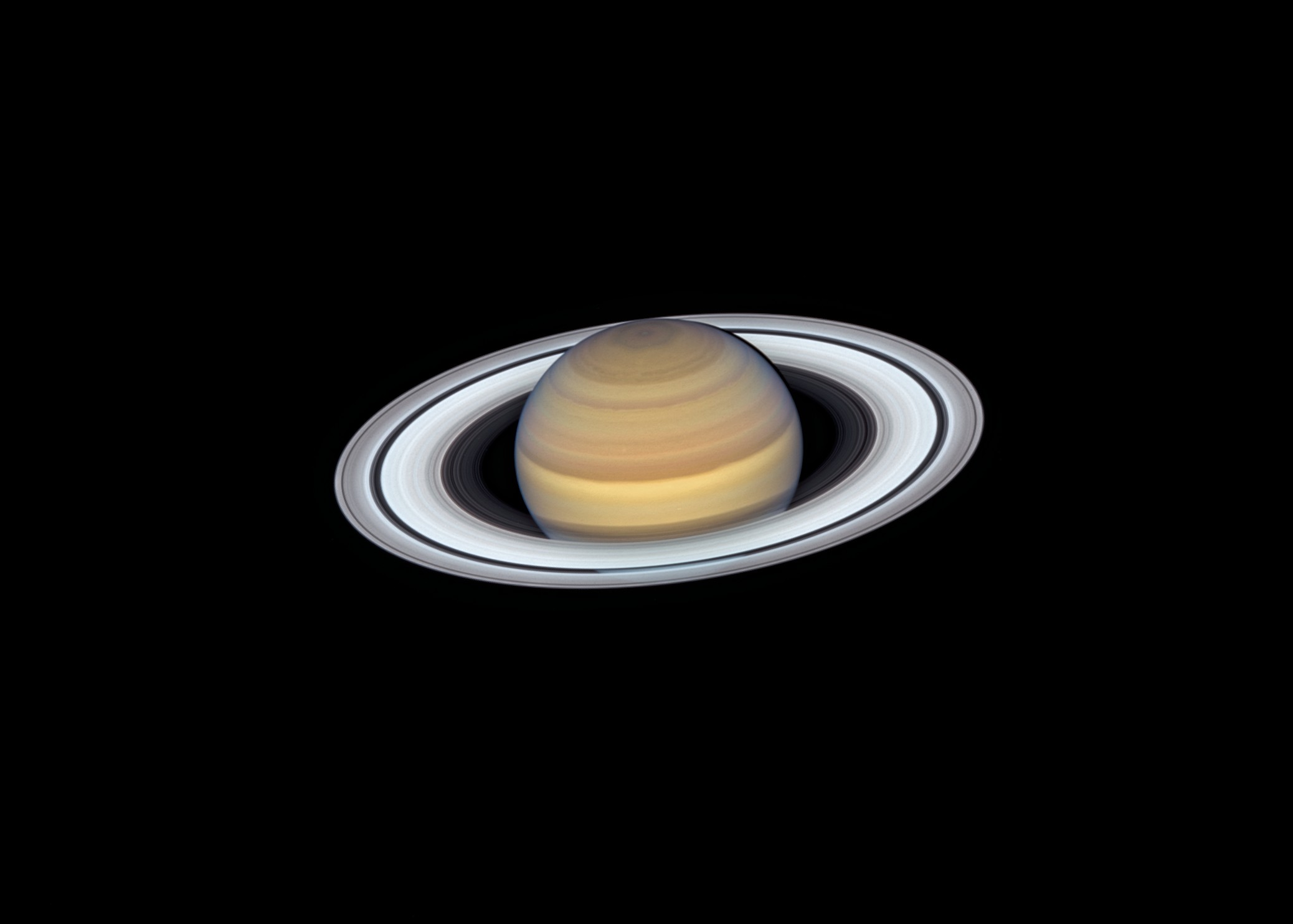
Caltech researchers analyzed Cassini data (2004–2017), tracking C ring 'notes' to map Saturn's interior. Published in Nature Astronomy, their findings describe a colossal core: 55 times Earth's mass, spanning 60% of Saturn's radius.
Contrary to expectations of a sharp boundary between a rocky-icy core and hydrogen-helium envelope, this core gradually blends into gaseous layers, lacking distinct edges.
Lead author Christopher Mankovich notes these insights support gas giant formation via gradual core-building from space rocks, accreting gas to form the planet—a process validated by Saturn's structure.
