Astronomers have identified a group of young stars and gas clouds protruding from the Sagittarius arm of the Milky Way, spanning 3,000 light-years—the first such structure detected in our galaxy.
Mapping the Milky Way's spiral arms from within poses significant challenges for astronomers. Vast distances prevent direct external views, so researchers rely on advanced telescopes and data analysis. Recent work has revealed an unexpected feature.
A team analyzed infrared data from NASA's Spitzer Space Telescope to detect young stars, then used ESA's Gaia mission for precise distance measurements. This approach uncovered a cluster of stars and nebulae moving coherently at the same speed and direction, forming a structure about 3,000 light-years wide that extends beyond the Sagittarius arm (see image below).
“A key property of spiral arms is the tightness of their winding,” explains Michael Kuhn, astrophysicist at Caltech. “This is quantified by the pitch angle: 0 degrees for a circle, increasing as the spiral opens. Models predict about 12 degrees for the Sagittarius arm, but this feature deviates sharply at nearly 60 degrees.”
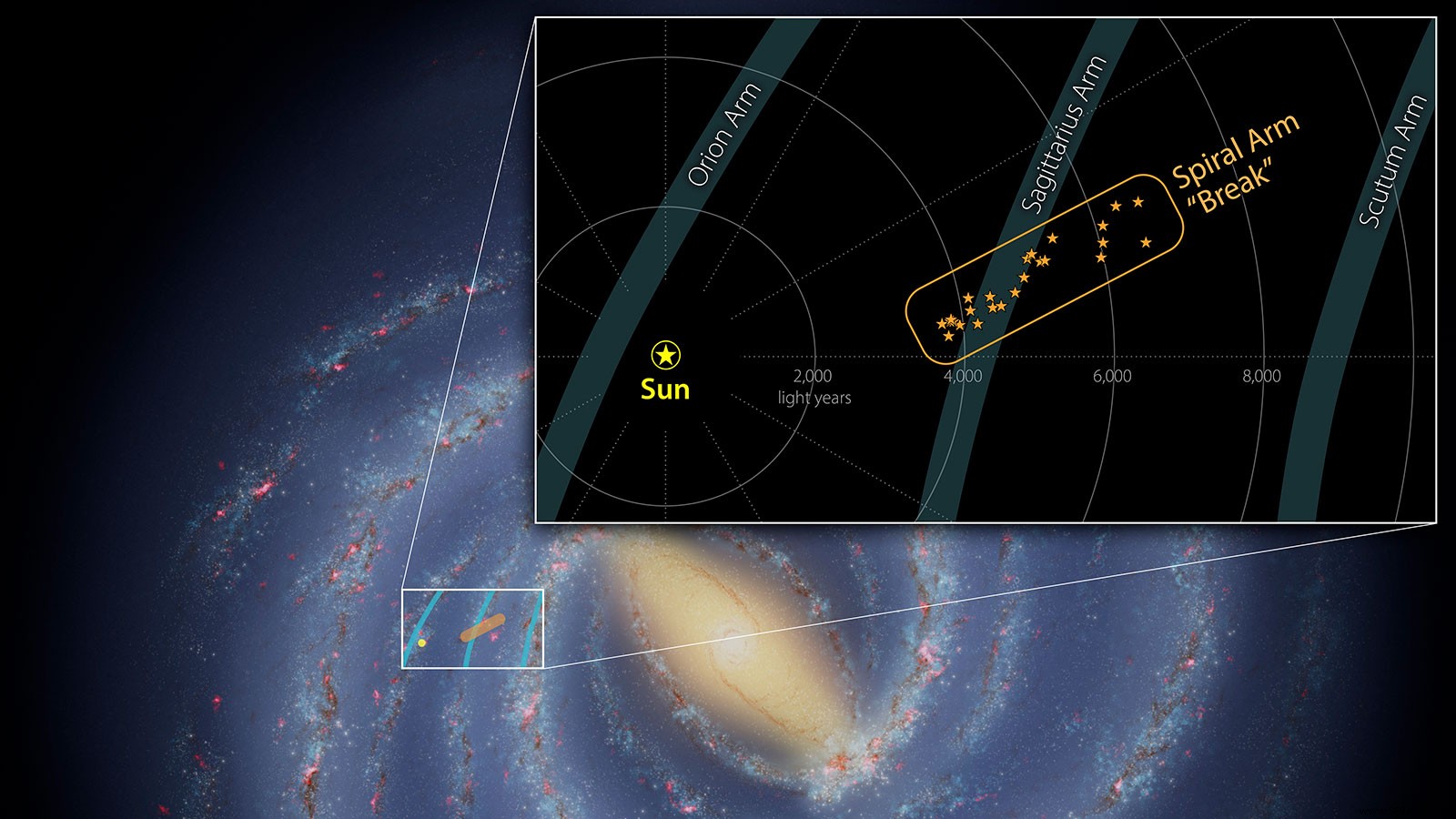
Such protrusions have been observed in other spiral galaxies, but this is the first in the Milky Way.
The structure includes iconic nebulae: the Eagle Nebula (home to the Pillars of Creation), Omega Nebula, Trifid Nebula, and Lagoon Nebula. Historical observations from the 1950s confirmed the Sagittarius arm's existence but lacked the precision to reveal this offset—now possible with modern data.
The cause of this 'break' remains unclear, mirroring broader uncertainties in spiral arm formation. Precise stellar motion data from Gaia will be crucial for unraveling these dynamics.
“This discovery highlights gaps in our knowledge of the Milky Way's large-scale structure,” notes Robert Benjamin, University of Wisconsin-Whitewater astronomer and study co-author. “Though small in galactic terms, it may reveal key insights about the whole.”
