Astronomers predict the James Webb Space Telescope (JWST) will capture a fourth image of a supernova first spotted by Hubble in 2016, thanks to gravitational lensing. This rare event is set for 2037.
Astronomers can forecast events like solar eclipses or comet returns with remarkable accuracy. Deeper cosmic phenomena, however, pose greater challenges. On September 13, 2021, NASA announced a striking prediction: a supernova explosion— the dramatic end of a massive star—will become visible again in 2037, or 16 years from now. Observable only through powerful telescopes, this forecast comes from researchers at the University of South Carolina's Department of Physics and Astronomy, published in Nature Astronomy.
Experts anticipate a fourth, brighter image emerging near the core of galaxy cluster MACS J0138. Positioned in the foreground, this massive cluster acts as a gravitational lens, bending and amplifying the supernova's light for enhanced observation. "When light from a distant object passes very close to a foreground galaxy or cluster, gravitational lensing can cause it to appear as multiple images in the sky," the researchers explain.
This lensing effect created the three "mirror images" Hubble captured, visible in the white circles on the image below:
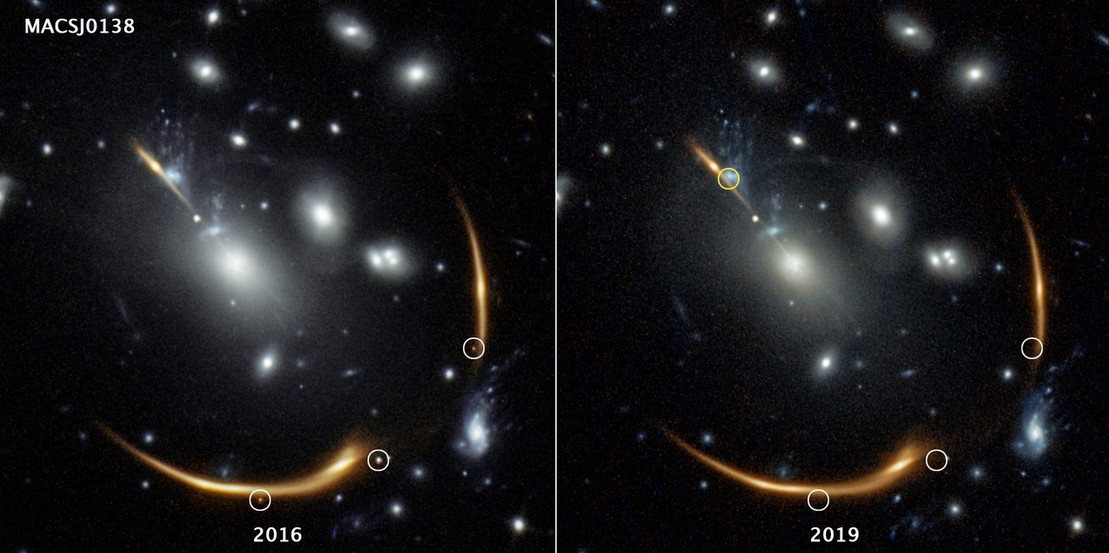
The light Hubble detected in 2016 took about four billion years to reach Earth. Using near-infrared observations and computer models of light paths through the lensing cluster, scientists pinpointed the timing. NASA likens it to trains leaving the same station at the same speed but via different routes, arriving at varied times—explaining the fourth image's delay until 2037.
With Hubble facing a major failure in June 2021 and slated for deorbiting, the JWST—launched in December 2021—stands ready to detect this image, potentially revealing new phases of the supernova's evolution.
