Establishing a human colony on Mars faces a major hurdle: sourcing affordable building materials. Shipping them from Earth is prohibitively expensive. Now, researchers propose innovative on-site solutions using astronauts' blood, sweat, tears, and urine.
Traveling to Mars, setting up a base, and scaling to a colony poses immense challenges, many still unresolved. Visionaries like Elon Musk dream of Martian settlements, but transporting construction materials from Earth is unfeasible—the cost per brick exceeds $2 million. Colonists must rely on local resources.
Martian rocks, soil, and scarce water ice are promising, but scientists at the University of Manchester (UK) offer a groundbreaking alternative. In their September 2021 study published in Materials Today Bio, they highlight the crew as a vital resource. Human serum albumin—a prevalent blood plasma protein—serves as an effective binder for Martian (and lunar) dust, creating a concrete-like material.
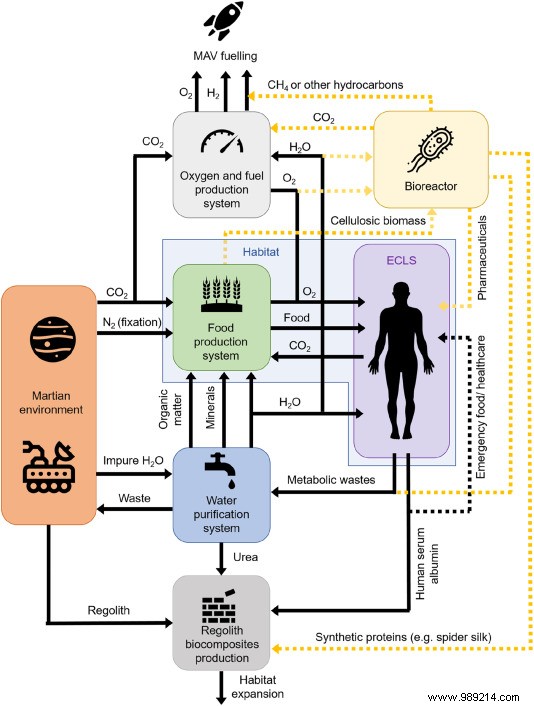
Albumin "curdles" to form robust beta sheet structures, a well-understood scientific process. Historically, animal blood has bound mortar since the Middle Ages, a precedent for this space-age application.
The resulting material, dubbed AstroCrete, achieves a compressive strength of 25 megapascals (MPa)—on par with standard concrete (20-32 MPa). Adding urine, sweat, or tears boosts it to 40 MPa. Researchers estimate a six-person crew could produce 500 kg during a two-year mission.
