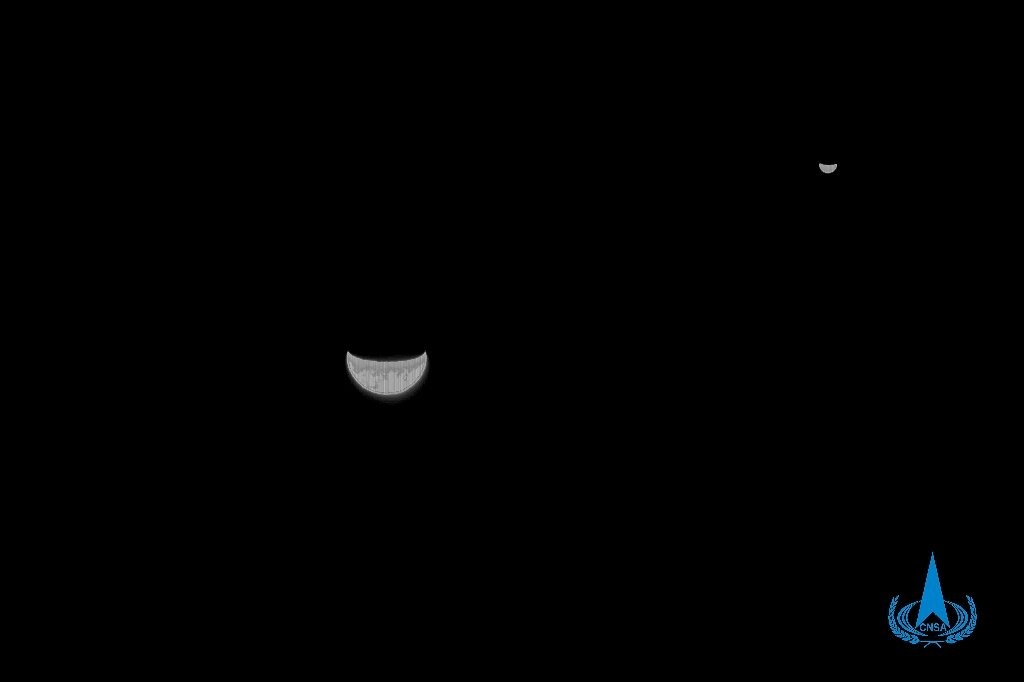
China's Tianwen-1 mission, now hurtling toward Mars, has delivered a striking black-and-white photo of Earth and the Moon from approximately 1.2 million kilometers away.
Launched on July 23, 2020, Tianwen-1 marks China's ambitious first attempt at Mars exploration, featuring an orbiter and a rover. Mission control recently trained the spacecraft's optical navigation sensor on the Earth-Moon system, revealing two delicate crescent shapes drifting "into the vast universe," as reported by Xinhua News Agency. The image was captured from over 1.2 million kilometers distant.
This evocative shot joins an esteemed collection of Earth portraits from deep space, including those from Voyager, Cassini, Mars Express, Mars Reconnaissance Orbiter, and the Apollo missions. For a curated gallery, check out Universe Today.
Tianwen-1 is slated to arrive at Mars in February 2021. The rover will orbit for about two months before descending to Utopia Planitia, a vast northern plain spanning roughly 3,200 km.
To date, NASA holds the record for successful Mars landings since the late 1990s, deploying four rovers. Efforts by the Soviet Union and ESA have unfortunately fallen short.
Designed for at least 90 Martian sols, the rover will investigate Mars' surface morphology, geology, soil properties, water ice distribution, ionosphere, physical fields, and internal structure.
Seizing the optimal Earth-Mars alignment, the UAE launched Hope on July 19, 2020, to study Martian climate and atmosphere. NASA's Perseverance rover (Mars 2020) lifted off July 30, seeking ancient life signs and caching samples for potential Earth return.
