Rock samples from Japan's Ryugu asteroid, studied in a new Nature Astronomy paper, rank among the most primordial materials ever examined on Earth, offering key insights into Solar System origins.
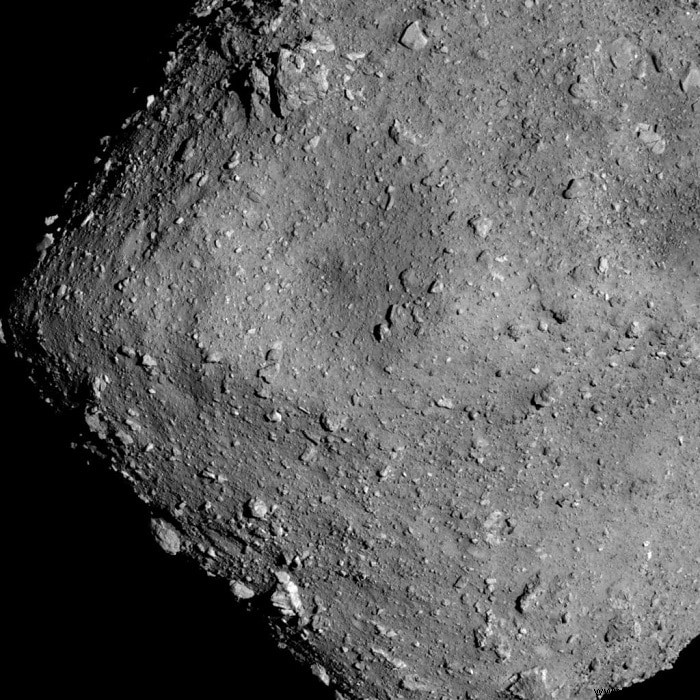
Ryugu, a 900-meter-diameter carbonaceous (C-type) asteroid, orbits about 350 million kilometers from Earth, spinning like a top. Like other C-type asteroids, it likely preserves material from the solar nebula that birthed the Sun and planets over 4.6 billion years ago.
In a landmark mission, Japan's space agency JAXA collected these samples a few years ago. They touched down at Australia's Woomera Range Complex on December 6, 2020.
Scientists eagerly analyzed them in labs, as Ryugu's materials could illuminate Solar System formation, asteroid evolution, and the role of carbon-rich bodies in life's emergence on Earth.
A team detailed initial findings in Nature Astronomy.
The haul totals approximately 5.4 grams, with largest particles up to eight millimeters across and smallest under one millimeter. Handled in vacuum chambers or nitrogen-filled enclosures, they avoided Earth's atmosphere.
Using optical microscopes and spectrometers, researchers measured light absorption, emission, and reflection in visible and infrared ranges.
These samples reflect just 2% to 3% of incident light, making them among the darkest ever studied.
Exact ages await further dating, but they're exceptionally ancient. "We are only at the beginning of our investigations, but our results suggest that these samples are among the most essential materials available in our laboratories," says Cédric Pilorget of the University of Paris-Saclay's Institute of Space Astrophysics.
Surprisingly low density—mass per volume below known carbonaceous meteorites—indicates high porosity, potentially allowing water infiltration. Traces of ammonia-rich compounds hint at the asteroid's origins.
These are preliminary scans; unlocking Ryugu's full story will take time. "A lot of data will come from combining additional techniques, especially those accessing very fine scales," notes Pilorget.
Future analyses will reveal formation timelines, water exposure ages, organic and mineral compositions, and solar wind effects on its surface.
