Just over 12 hours after its Ariane 5 launch, the James Webb Space Telescope's thrusters fired successfully, executing one of the mission's most vital maneuvers en route to the L2 Lagrange point.
After years of anticipation, the moment arrived. On Saturday, December 25 at 1:20 p.m. French time, engineers, astronomers, and space enthusiasts watched as Ariane 5 lifted off from French Guiana, carrying the most advanced space observatory ever built. Designed to expand our understanding of the universe and unravel astrophysics' deepest mysteries, it now embarks on a precise journey to the L2 point, over 1.5 million kilometers from Earth.
Along the way, the observatory must complete several key maneuvers to ensure mission success.
The first major one succeeded approximately 12.5 hours post-launch, when the telescope, about 160,000 km from Earth, performed a thruster burn to fine-tune its path toward L2.
Such corrections are standard shortly after launch, often involving deceleration. For Webb, however, turning toward the Sun to slow down risked exposing its sensitive instruments. Instead, the launch was calibrated for slightly underpowered velocity, allowing this burn—known as Mid-Course Correction Burn 1a (MCC1a)—to accelerate and refine the trajectory.
NASA confirms this as the largest of three planned burns and the only one with such precise timing requirements.
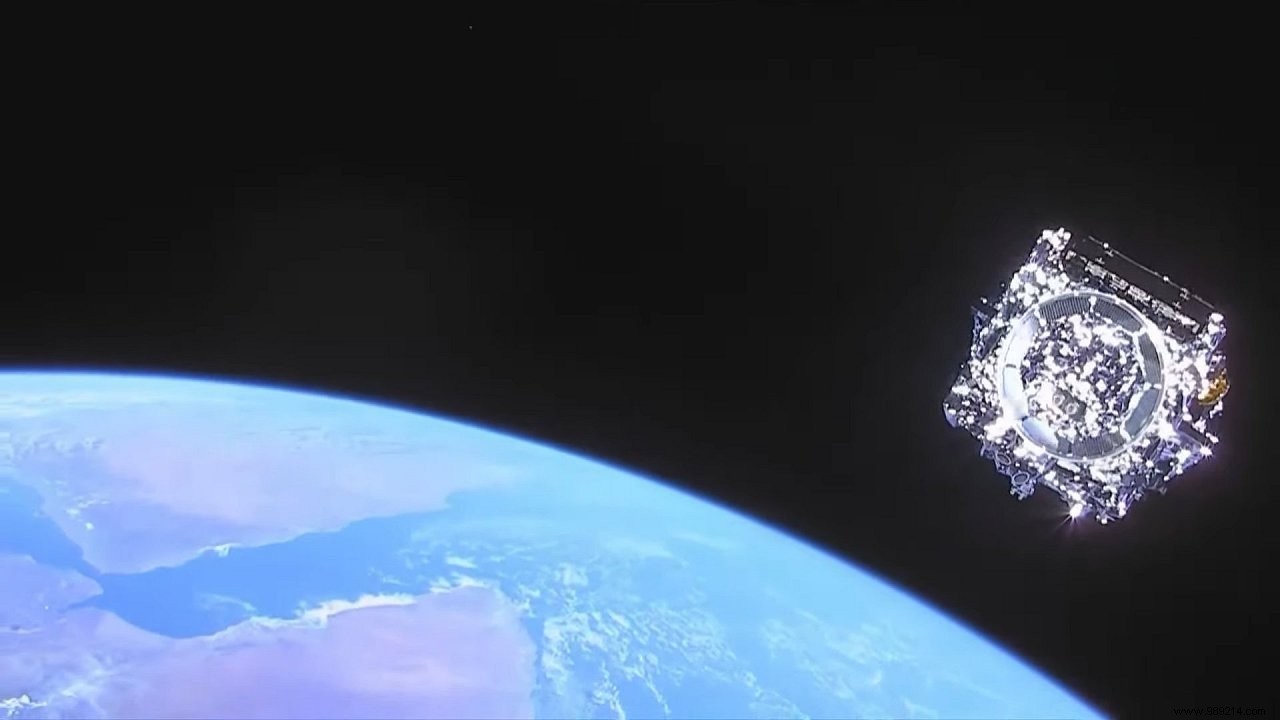
By day three—this Tuesday—the sunshield deployment begins, protecting the infrared sensors by blocking sunlight and enabling ultra-low operating temperatures essential for deep-space observations. This complex process, involving around 7,000 parts, is slated for the coming days.
On day six, the secondary mirror unfolds, followed by the primary mirror the next day. Each step is critical; any failure could jeopardize the mission. Finally, about a month after launch, Webb will arrive at L2.
