Recent studies confirm that the dwarf planet Ceres is an ocean world, harboring liquid, salty water beneath its surface.
Discovered by Giuseppe Piazzi in 1801, Ceres is the largest object in the asteroid belt between Mars and Jupiter. Once viewed as a barren rock, it captured scientific attention during NASA's Dawn mission in 2015.
Dawn identified unusually bright spots, known as faculae, in the 20-million-year-old Occator Crater. Scientists hypothesized these were sodium carbonate deposits—a salt associated with Earth's hydrothermal vents, potential sites of ancient life.
Debate ensued: some suggested melted subsurface ice from the impact, while others proposed a deep brine layer that erupted upon impact and froze on the surface.
Fresh analyses of Dawn data support the latter scenario. Published in Nature Astronomy, Nature Geoscience, and Nature Communications, these findings draw from the mission's final phase.
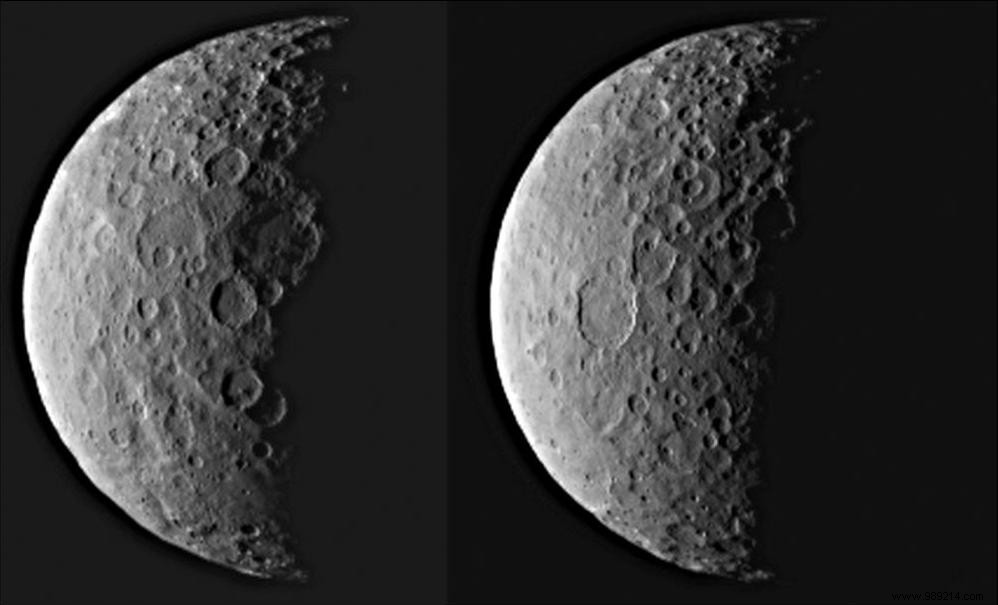
During its closest approach—less than 35 kilometers above Occator Crater—Dawn's gravity and thermal data revealed density variations indicating a deep brine reservoir. The impact likely mobilized this brine, propelling it to the surface to form the observed salt deposits.
Ceres' crust shows decreasing porosity with depth, suggesting subsurface mixing of rock and salts.
At the brightest dome's peak, researchers detected hydrohalite, a hydrated sodium chloride form common in sea ice but previously unseen beyond Earth. Requiring high humidity and degrading within centuries, its presence implies recent exposure.
Maria Cristina De Sanctis from Rome's Istituto Nazionale di Astrofisica states, "We can now say that Ceres is a kind of ocean world, just like some moons of Saturn and Jupiter."
Subsurface water may persist, prompting NASA to consider new missions, including a rover concept under study for the 2023 Planetary Science Decadal Survey.
