Officials from the Utah Department of Public Safety (DPS) recently spotted a striking metal monolith standing alone in the state's remote desert landscape. Its origins remain unknown, though many draw parallels to the iconic structure in 2001: A Space Odyssey.
The unusual discovery occurred by chance during a routine helicopter survey. A DPS crew, partnering with the Utah Division of Wildlife Resources (DWR), was counting bighorn sheep in one of Utah's most rugged and isolated regions, where these resilient animals thrive amid extreme conditions. There, embedded firmly in the ground, stood the structure—measuring over three meters tall.
Questions abound: Why is it here? How was it placed in such an inaccessible spot? And how long has it been standing? For now, answers elude investigators.
Speculation ranges from an art installation to a deliberate homage to the monolith in Stanley Kubrick's 1968 masterpiece 2001: A Space Odyssey, co-written with Arthur C. Clarke. In the film, an alien intelligence places the black slab to catalyze human evolution. This real-life version gleams brightly, standing out vividly against the surrounding red rock formations.
Others note similarities to the polished stainless steel sculptures of artist John McCracken, who worked in New Mexico and New York until his death in 2011, as reported by The Guardian.
The find has captivated onlookers. "That's the weirdest thing I've encountered down there in all my years of flying," said pilot Bret Hutchings in an interview with local station KSL-TV. "We joked that if one of us suddenly disappeared, we'd all start running."
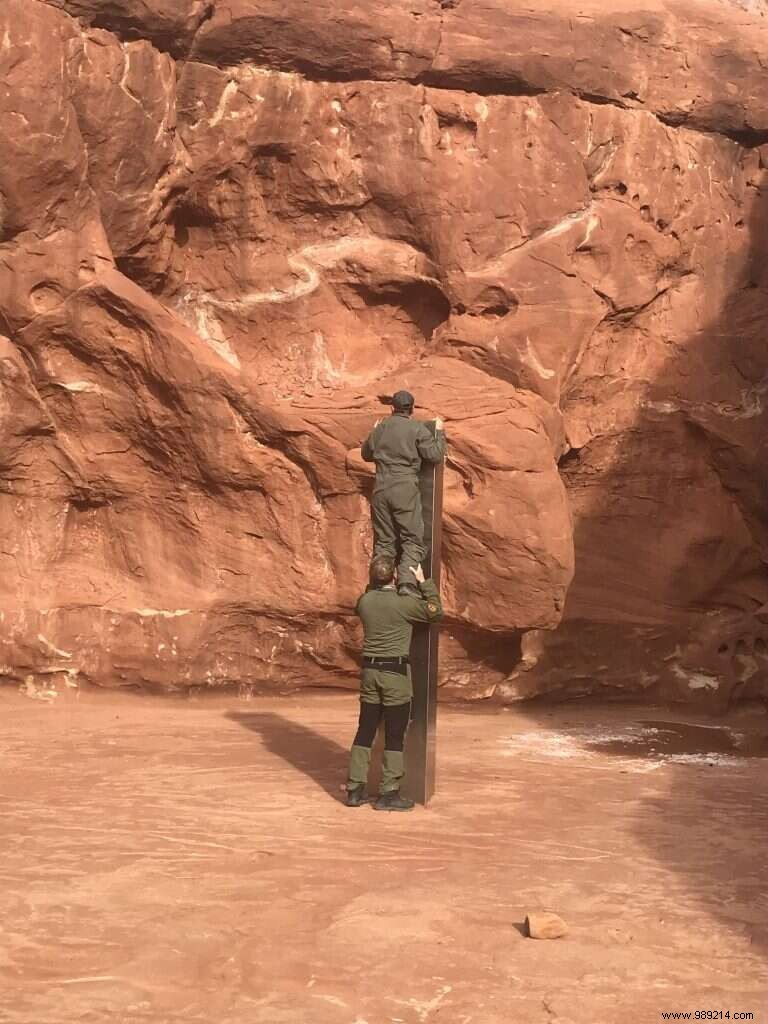
While pinpointing the site could boost tourism in the Covid-hit region, DPS is withholding coordinates to protect the area. Installing it required significant effort, given the site's remoteness—accessible only by helicopter for wildlife surveys.
