A strikingly long and slender water ice cloud has reemerged over Mars' massive 20-km-high shield volcano, Arsia Mons. Scientists anticipated its return, yet the exact processes driving its formation remain an intriguing puzzle.
This isn't a volcanic smoke plume—it's composed of water ice crystals. ESA's Mars Express orbiter captured it on July 19 using its Visual Monitoring Camera (VMC), hovering above Arsia Mons, a colossal shield volcano near the Martian equator that's been dormant for 50 million years.
Stretching several hundred kilometers—this instance an impressive 1,800 km—these clouds reliably form along the volcano's slope opposite the prevailing winds. They appear annually around Mars' southern solstice, equivalent to Earth's winter solstice, when the Sun reaches its southernmost position in the sky, just as on December 21.
During this season, a transient cloud develops each early morning, lasting about three hours before swiftly dissipating. This daily display repeats for roughly 80 days.
For context, a Martian sol (day) lasts 24 hours, 39 minutes, and 35 seconds—slightly longer than Earth's. A Martian year spans 668 sols or about 687 Earth days, meaning seasons endure nearly twice as long.
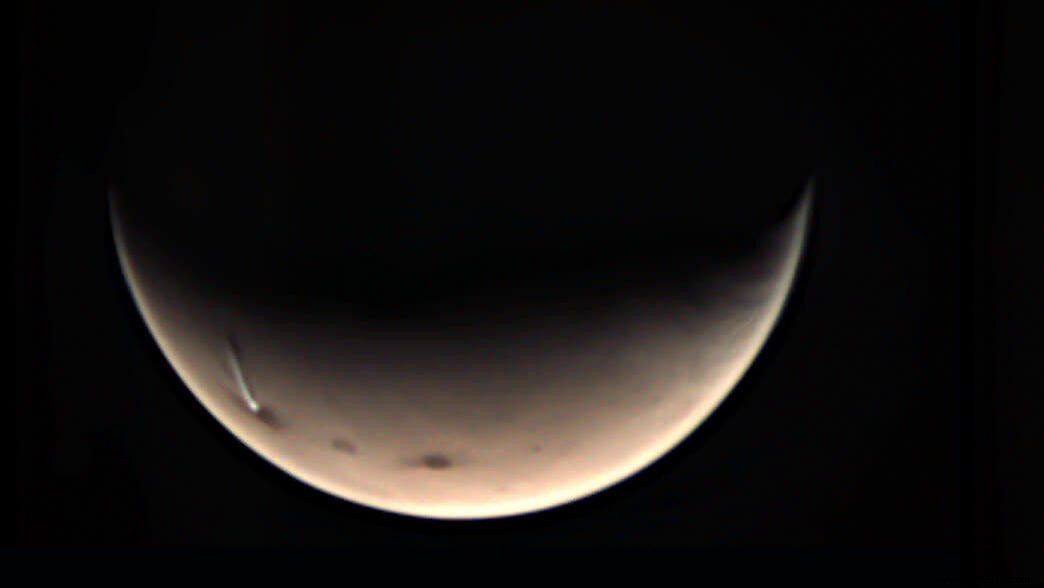
Most spacecraft orbiting the Red Planet occasionally glimpse this event, but their orbits limit views to early afternoons with narrow-field cameras.
Mars Express stands out with its wide-field VMC and highly elliptical orbit, allowing broad early-morning images of Mars to capture this elusive cloud.
It was similarly documented in 2018, forming late September, extending 1,500 km, and fading by mid-October.
The formation of these water ice clouds remains enigmatic: scientists are still unraveling how and why they emerge seasonally, and for how long this has occurred.
