Geophysicists from Evolution Mining, Australia's third-largest gold producer, have identified one of the world's largest known impact craters while prospecting in Western Australia. Dated to approximately 100 million years ago with a diameter of nearly five kilometers, it ranks among the most significant meteorite craters ever found.
Jayson Meyers, a geophysicist at Evolution Mining, shared details of this groundbreaking find in an ABC News article on August 2, 2020. While exploring for gold near the mining town of Ora Banda, about 10 kilometers northwest of Kalgoorlie-Boulder, Meyers and his team detected the massive structure. Meyers notes its diameter of almost five kilometers makes it five times larger than the well-known Wolfe Creek crater.
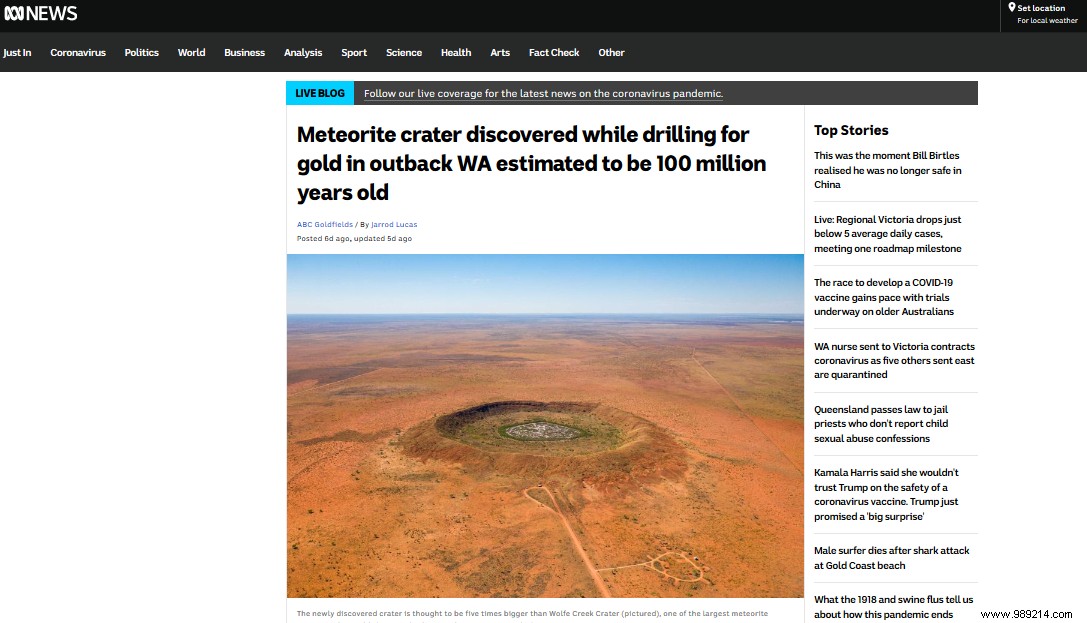
Using gravimetric surveys and core samples, the team determined the crater's age at roughly 100 million years, placing its formation in the Cretaceous period—predating Mexico's Chicxulub crater, which measures 100 km across and is linked to the dinosaur extinction.
Meyers explains that the crater lies in a remarkably flat region, where it was gradually filled and obscured over geological time. This discovery suggests Earth may have endured more asteroid impacts than previously estimated. As Meyers highlights, such finds are rare and could shift our perspective, prompting experts to better assess impact frequency and causes.
Core samples reveal percussion cones—distinctive rock fractures shaped like diverging cones, signature features of meteorite impacts (or nuclear blasts). Analysis of the crater's size and required energy indicates the impacting body measured 100 to 200 meters across, with its speed determined by gravitational acceleration.
