In recent months, astronomers worldwide puzzled over a small, enigmatic object on an unusually Earth-like trajectory. Experts ruled out a mini-asteroid or temporary moon, identifying it instead as human-made space debris.
Astronomers spotted the small body 2020 SO in September 2020, but its identity remained elusive for weeks. Its orbit closely mirrored Earth's, and its path suggested it would temporarily become a satellite of our planet for several months (see animation below).
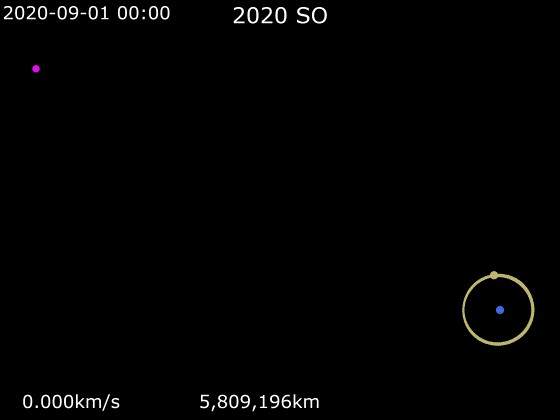
On December 2, 2020, NASA issued a press release confirming 2020 SO as the upper-stage thruster from the Centaur rocket of the failed Surveyor 2 mission, launched September 20, 1966, toward the Moon. This 12 m long by 3 m wide rocket stage had been orbiting the Sun ever since.
To pinpoint its origins, researchers like Marco Micheli, astronomer at the European Space Agency's (ESA) Near-Earth Object Coordination Centre, measured its position. The object's solar radiation pressure signature was notably strong, indicating it was far too lightweight for a natural body.
Vishnu Reddy, professor and planetary scientist at the University of Arizona's Lunar and Planetary Laboratory, led spectroscopic observations of 2020 SO using NASA's Infrared Telescope Facility (IRTF) on Mauna Kea, Hawaii. Complementary data from the Large Binocular Telescope (LBT) in Arizona confirmed it wasn't an asteroid.
Reddy's team compared 2020 SO's spectrum to 301 stainless steel, the material used in 1960s Centaur boosters. While not a perfect match—due to 54 years of harsh space weathering—it aligned closely with a 1971 Centaur D booster spectrum, sealing the identification.
The object made its closest approach to Earth on December 1, 2020, at just 50,000 km. It lingered within Earth's Hill sphere until May 2021, before resuming its solar orbit.
