Astronomers probing the core of a globular cluster relatively close to Earth expected to find an intermediate-mass black hole. Instead, they discovered a concentration of smaller, stellar-mass black holes. The study, led by experts from the Institut d'Astrophysique de Paris, is published in Astronomy & Astrophysics.
Globular clusters are dense, spherical collections of hundreds of thousands of stars, spanning 20 to a few hundred light-years. Their stars formed simultaneously from the same gas cloud, making these structures ancient "fossils" from the early Universe. The Milky Way hosts about 150 known globular clusters, with potentially more awaiting discovery.
Located approximately 7,800 light-years from Earth, NGC 6397 ranks among our closest globular clusters. Researchers Eduardo Vitral and Gary A. Mamon from the Institut d'Astrophysique de Paris analyzed it for signs of an intermediate-mass black hole.
These "middleweight" black holes bridge the gap between stellar-mass black holes (up to about 100 solar masses) and supermassive ones (millions to billions of solar masses) at galactic centers.
Theoretical models suggested such an object could anchor the gravitational core of globular clusters, and NGC 6397's properties made it a prime candidate.
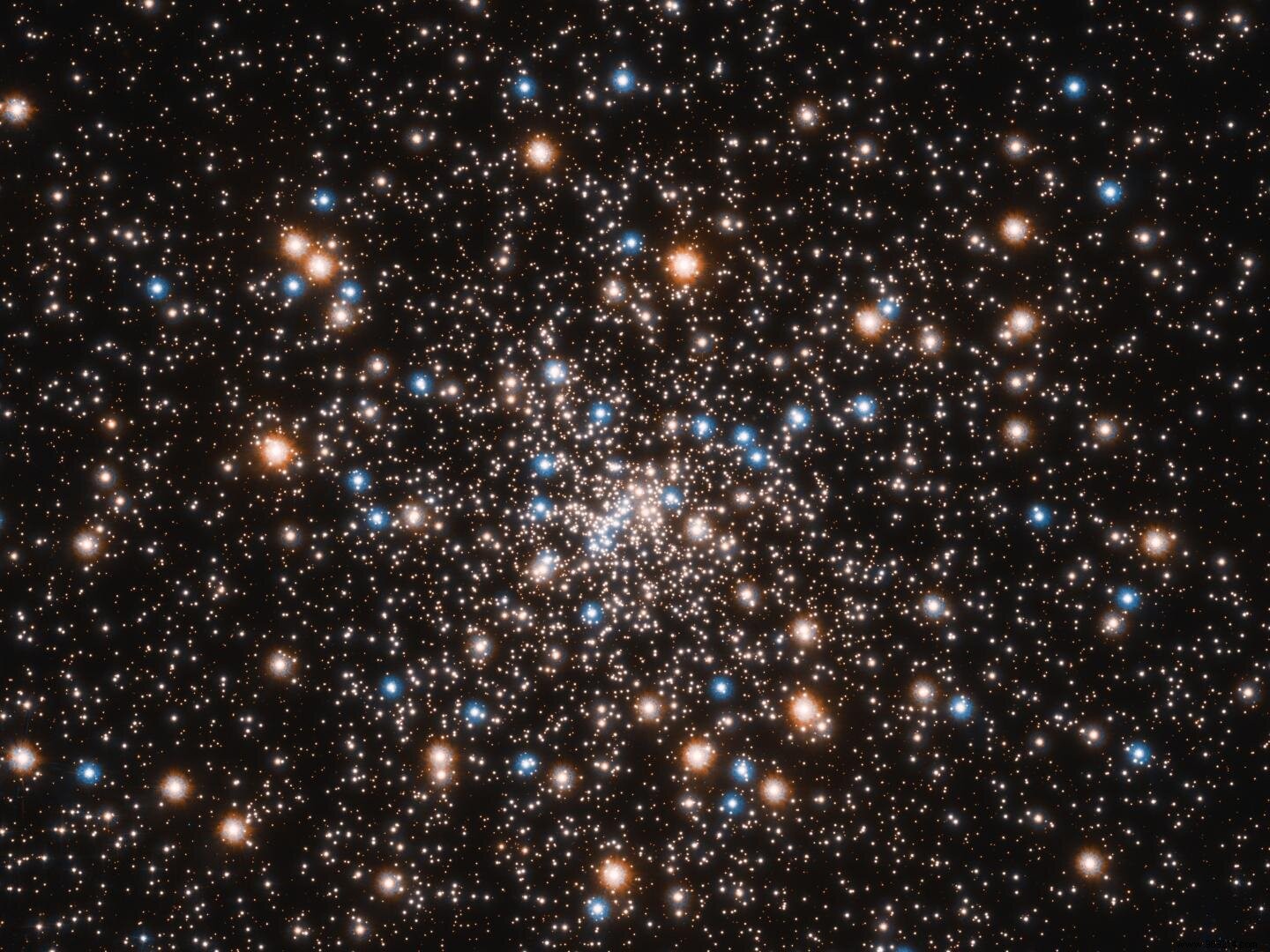
Using multi-year Hubble Space Telescope images combined with precise stellar position, distance, and motion data from ESA's Gaia satellite, the team mapped the cluster's inner mass distribution.
"We found compelling evidence for invisible mass in the cluster's dense core," says lead astronomer Eduardo Vitral. "Surprisingly, this mass isn't concentrated in a single point but spread across a region comprising a few percent of the cluster's size."
Denser "dead" stars like white dwarfs, neutron stars, and black holes naturally segregate toward cluster centers, displacing less massive main-sequence stars outward.
Detailed modeling revealed this central invisible mass consists not of an intermediate-mass black hole, white dwarfs, or neutron stars, but a concentration of stellar-mass black holes.
"Our analysis is the first to quantify both the mass and spatial extent of what appears to be a population dominated by black holes in a core-collapsed globular cluster," Vitral emphasizes.
This discovery refines searches for intermediate-mass black holes by identifying clusters with similar central dynamics. It also highlights how multiple stellar-mass black holes can accumulate at cluster cores.
Over time, these black holes may interact and merge, potentially forming intermediate-mass black holes. Such mergers could produce detectable gravitational waves with advanced instruments.
