Astronomers using the European Southern Observatory's (ESO) Very Large Telescope Interferometer (VLTI) have captured the sharpest-ever images of stars orbiting the supermassive black hole at our galaxy's core—zooming in 20 times sharper than before.
For decades, astronomers suspected a supermassive black hole lurks at the Milky Way's center. Confirming it was challenging, as gravitational effects could stem from dense neutron star clusters. But in 2002, doubts were dispelled.
Led by Reinhard Genzel from Germany's Max Planck Institute for Extraterrestrial Physics, the team used precise optical observations to scrutinize this region.
They tracked a faint star, now called S2, hurtling just 17 light-hours from the galactic center at incredible speeds—mere three times the Pluto-Sun distance.
Only a supermassive black hole could impart such acceleration, the researchers concluded.
Genzel's ongoing observations provided mounting evidence, earning the 2020 Nobel Prize in Physics.
Research continues unabated. Genzel's team, building on nearly three decades of data on stars around Sagittarius A*, employed ESO's GRAVITY instrument on the Very Large Telescope in Chile for these record-breaking, deepest images.
They refined orbits of known stars nearing the black hole. Star S29, in May 2021, approached within 13 billion kilometers—90 times the Earth-Sun distance—at 8,740 km/s. No other star has come closer or faster.
They also spotted a new star, S300.
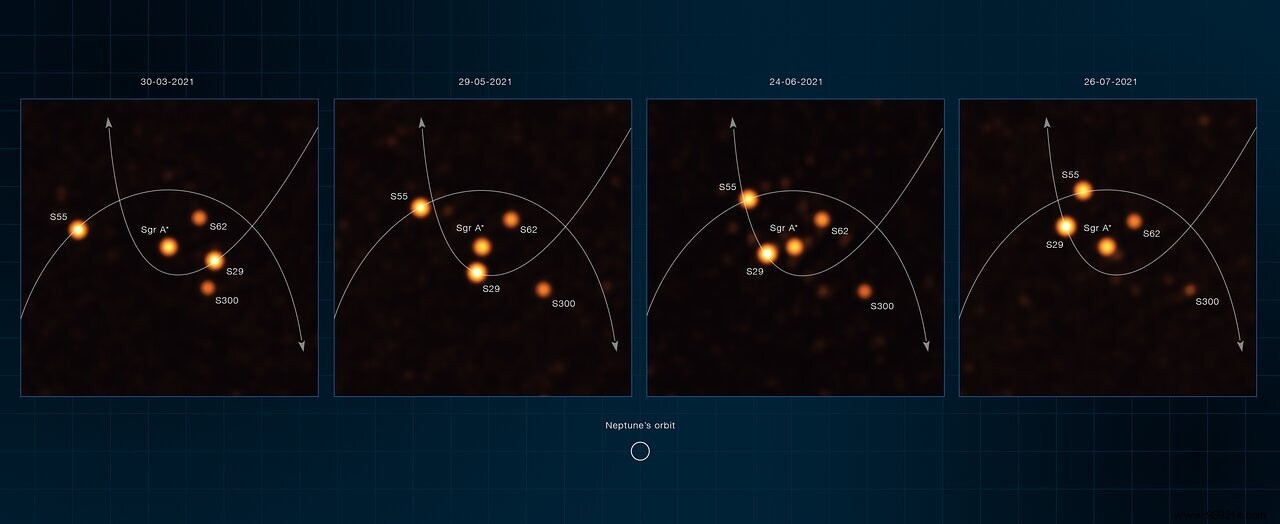
These observations align perfectly with Einstein's general relativity predictions for stellar paths near Sagittarius A*.
The team refined the black hole's mass to 4.3 million solar masses, at a distance of 27,000 light-years from Earth.
Upcoming GRAVITY upgrades and ESO's Extremely Large Telescope (ELT) in Chile's Atacama Desert promise even sharper insights into fainter, closer stars.
