Astronomers have discovered a black hole weighing only three solar masses—one of the smallest ever found and the nearest to Earth at 1,500 light-years away, orbiting a red giant star.
Located 1,500 light-years from Earth in the constellation Monoceros—earning it the nickname 'The Unicorn'—this black hole is roughly three times the mass of our Sun, making it among the lightest confirmed to date.
When massive stars reach the end of their lives, they collapse under gravity to form black holes. Less massive ones become neutron stars, typically not exceeding 2.5 solar masses.
Theorists long predicted a 'mass gap' between 2.5 and 5 solar masses, questioning what objects might occupy it. About 18 months ago, researchers at Ohio State University published compelling evidence in Science for black holes in this range, spurring young astronomer Tharindu Jayasinghe and his team to search for them—leading to the Unicorn.
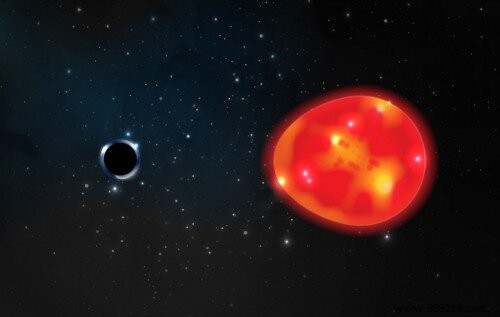
The black hole resides in a binary system with a red giant star. Subtle variations in the star's light intensity and shape revealed its presence: an unseen companion exerting gravitational pull.
This 'tidal distortion' mirrors how the Moon deforms Earth's oceans. As co-author Todd Thompson explains, "Just as the Moon's gravity warps Earth's oceans into tides, a massive object can elongate a star along one axis." The simplest explanation? A black hole.
Orbital speed and gravitational effects pinpointed its mass at approximately three solar masses.
For decades, the mass gap between neutron stars and black holes remained mysterious. This discovery confirms 'mini black holes' exist within it.
Jayasinghe and colleagues detail their findings in a paper accepted by Monthly Notices of the Royal Astronomical Society, available as a free preprint on arXiv.org.
