Astronaut Michael Collins passed away on April 28, 2021, after a courageous battle with cancer. Best known as the Apollo 11 command module pilot, Collins orbited alone while Neil Armstrong and Buzz Aldrin made history on the lunar surface. For over 45 minutes on the Moon's far side, he was out of contact with Earth. What ran through his mind during this historic isolation?
Of the Apollo 11 crew who achieved humanity's first Moon landing in July 1969, only Buzz Aldrin survives today. Neil Armstrong died in 2012, and Collins followed on April 28, 2021. His family shared: "Mike always faced life's challenges with grace and humility, and like all the others, has now passed that great final test." They added, "We will miss him terribly. Yet we also know how lucky Mike was to have lived the life he lived."
"Today the nation lost a true pioneer and avid explorer," said NASA's acting administrator Steve Jurczyk at the time. "As pilot of the Apollo 11 Command Module—as his two crewmates walked on the Moon for the first time—he helped our nation achieve a monumental milestone."
During Apollo 11, as Armstrong and Aldrin descended to the surface, Collins orbited solo about 100 km overhead. For more than 45 minutes on the Moon's far side, he was beyond radio range—earning him the moniker "the loneliest man in history."
Reflecting in his 1974 memoir Carrying the Fire, he wrote: "I am now truly alone, and utterly isolated from any known life. I am it."
Yet Collins described the experience as tranquil. Speaking at a 2019 Explorers Club event in New York, he recalled: "Behind the Moon, it was very peaceful—no one from Mission Control nagging me to do this or that. So I enjoyed it; it was a peaceful place."
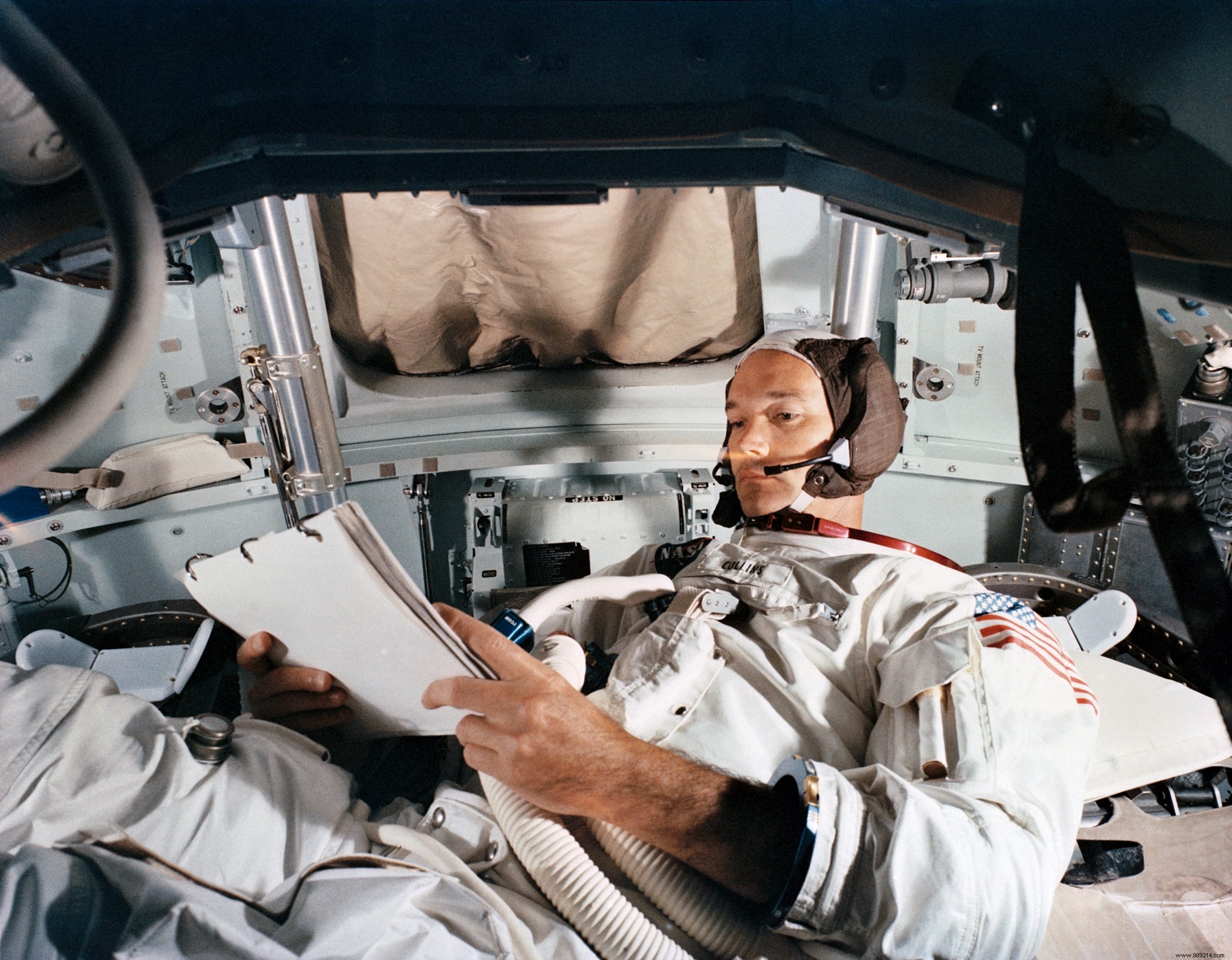
Orbiting wasn't entirely serene—Collins worried about his crewmates: a group of white lab mice aboard Columbia. Reviewing rendezvous procedures with the lunar module, his mind wandered to these tiny passengers.
Post-mission, the Apollo 11 astronauts underwent quarantine with lunar-exposed mice. Scientists monitored for any signs of "moon germs." Fortunately, the rodents thrived, confirming no extraterrestrial pathogens.
Thus, Collins savored a rare break from Mission Control while pondering his murine companions—far from Earth's bustle.

Collins' legacy extends far beyond Apollo 11. Born in Rome in 1930, he pursued a U.S. Air Force career as a fighter pilot, then test pilot at Edwards Air Force Base (1959–1963), amassing over 4,200 flight hours.
Selected as a NASA astronaut in 1963, his first spaceflight was Gemini 10 in 1966. He served as CAPCOM for Apollo 8 before Apollo 11, logging 266 hours in space total.
Retiring from NASA and the Air Force (as major general) in 1970, Collins held roles as Assistant Secretary of State for Public Affairs, director of the Smithsonian's National Air and Space Museum (1971–1978), and vice president at LTV Aerospace and Defense Co. From 1985, he worked as a consultant and lecturer before retiring.
