In just over a year, after traversing more than seven million miles, a refrigerator-sized spacecraft will slam into a small asteroid moon orbiting a larger one in NASA's DART mission. If successful, the impact will measurably alter the moon's trajectory, observable from Earth.
In March 1989, asteroid (4581) Asclepius—about 700 meters wide—passed just 700,000 km from Earth, making headlines. An impact would have unleashed energy equivalent to 20,000 hydrogen bombs, carving a 15-km-wide crater. Life within 60 km would have been obliterated, dust clouds disrupting crops for months. A sea strike could have triggered massive tsunamis affecting millions near coasts.
This close call prompted U.S. Congress to direct NASA to detect and track near-Earth objects. Today, NASA has cataloged over 90% of asteroids larger than 1 km and continues identifying those over 140 meters. Yet surprises remain possible, underscoring the need for proven deflection strategies.
Enter NASA's Double Asteroid Redirection Test (DART), slated for November launch aboard a SpaceX Falcon 9. The goal: kinetically impact an asteroid to change its path, validating planetary defense techniques.
Mission leader Andy Cheng selected a binary system for precise measurement: the spacecraft hits the smaller body, and scientists track its orbital shift around the larger one.
The target is the Didymos asteroid system, approaching closer to Earth next year than anytime in the next 50 years. Discovered in 1996, Didymos has a moon—Dimorphos (Didymoon)—spotted in 2003. Orbiting the Sun at 30 km/s, DART aims to alter Dimorphos' speed by just 1 millimeter per second in a single attempt.
One week prior, DART's autonomous navigation—leveraging APL missile guidance tech—activates to hone in on Dimorphos. The target comes into clear view only four minutes before impact, requiring a strike within 15 meters of aim point.
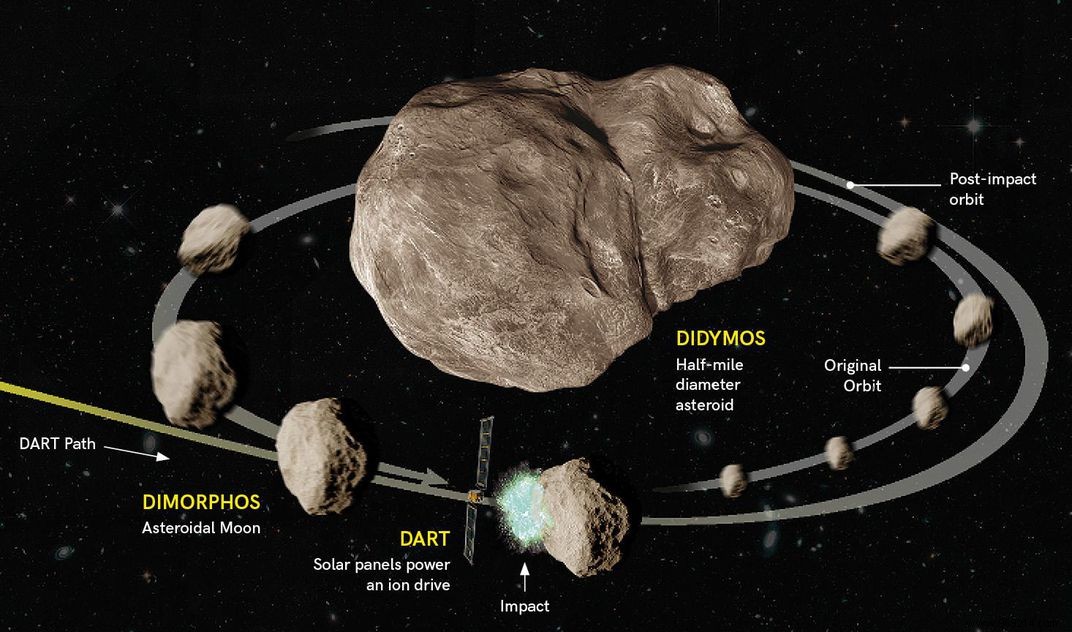
Too distant for direct imaging, astronomers will observe changes via Didymos' brightness variations. As Dimorphos advances relative to Earth, it slightly dims Didymos. Deviations from predicted light curves will confirm success.
DART carries Italy's LICIacube (LICIA) Cubesat, deploying pre-impact to image the collision. In 2024, ESA's Hera mission will rendezvous to survey the crater.
Uncertainties abound—from asteroid composition to ejecta effects and crater morphology—but that's precisely why DART is vital. These tests build critical knowledge for future threats.
