In roughly a year, NASA will launch its Artemis program—the most ambitious initiative since Apollo. Here's a comprehensive overview of Artemis 1, the critical first step.
In 2017, the Trump administration directed NASA to return humans to the Moon by 2024. This led to the Artemis program, unfolding in three initial stages. Artemis 1 is an uncrewed lunar orbit mission, followed by the crewed Artemis 2 lunar flyby and Artemis 3, which will land astronauts on the surface.
Ultimately, Artemis aims to establish sustainable outposts at the Moon's South Pole for extended human presence in deep space.
If timelines hold, Artemis 1 will lift off in November 2021 from Launch Complex 39B at Kennedy Space Center in Florida.
The mission features NASA's Orion capsule (designed for future crew transport, as shown in the header image) atop the Block 1 configuration of the Space Launch System (SLS), NASA's new heavy-lift rocket.
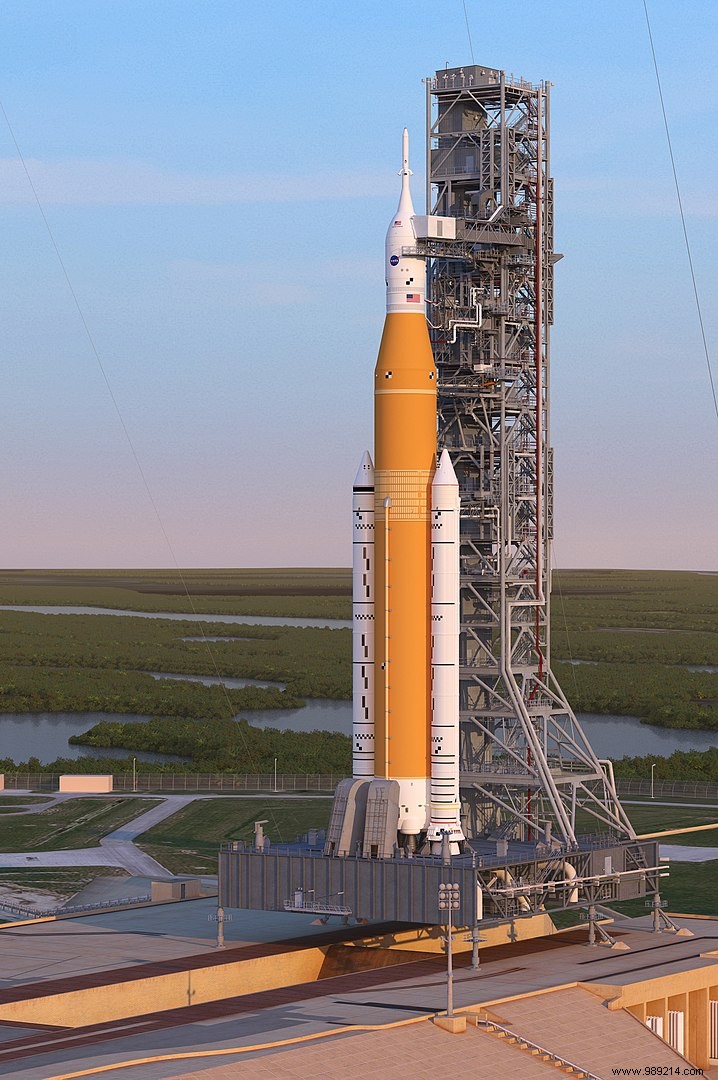
Spanning about 26 days, Orion will trace an Earth-Moon trajectory akin to Apollo 8: launching toward the Moon, skimming its far side at around 150 km altitude, entering a distant retrograde orbit for six days, then looping back for a low-altitude pass before reentering Earth's atmosphere and splashing down in the Pacific Ocean.
The diagram below illustrates the full trajectory:
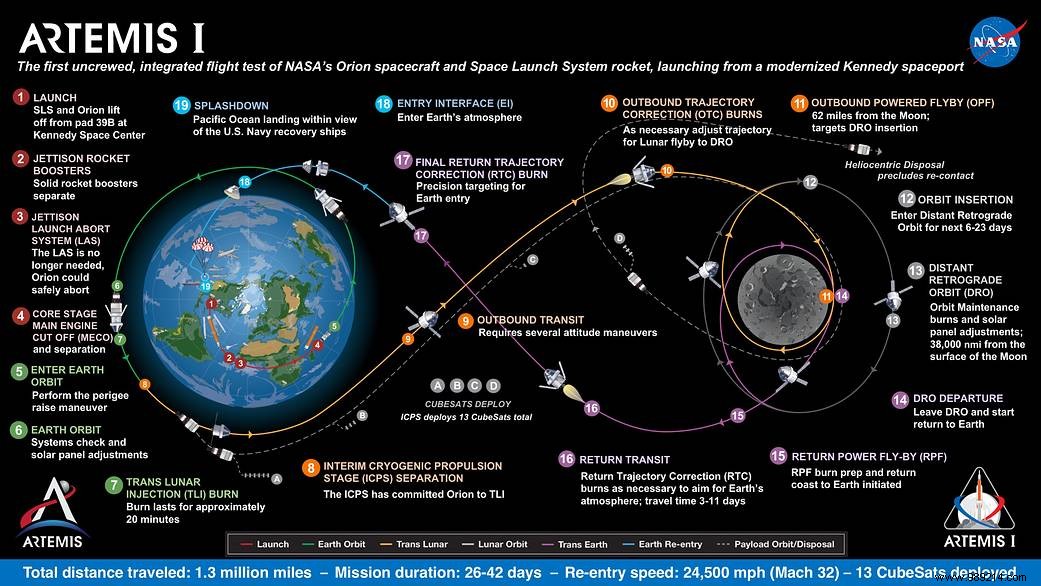
Artemis 1's primary goals are to validate the SLS rocket and Orion spacecraft across all mission phases in lunar vicinity, drawing on NASA's decades of expertise in human spaceflight.
Though uncrewed, Orion won't fly empty. The MARE experiment (MATROSHKA AstroRad Radiation Experiment) will assess radiation exposure beyond Earth's magnetosphere using sensors on two mannequins in crew seats.
Additionally, 13 CubeSats in the SLS second-stage adapter—selected via NASA's NextSTEP program—will deploy during the flight to advance deep-space technologies, partnering with industry to extend mission duration and capabilities.
