Japan's space agency, JAXA, is gearing up for its Martian Moon eXploration (MMX) mission to collect and return samples from Phobos by 2029. This ambitious endeavor aims to uncover the origins of Mars' moons, the Red Planet itself, and potentially traces of ancient life.
JAXA has confirmed development of the MMX mission, focused on landing on Phobos—Mars' larger moon—to collect samples. These will be returned to Earth for analysis using cutting-edge instruments. Launch is slated for 2024, with a return in 2029. If successful, Japan will beat NASA and ESA's joint mission, which plans to retrieve Perseverance rover samples in the early 2030s.
This builds on JAXA's proven expertise: the Hayabusa probe successfully sampled asteroid Itokawa in 2005 and returned material in 2010. More recently, Hayabusa2 brought back tens of grams from asteroid Ryugu.
The MMX spacecraft will arrive in the Mars system in 2025. It will observe Phobos and Deimos before entering a quasi-satellite orbit around Phobos for detailed study.
The probe will deploy a lander, which releases a rover to gather at least 10 grams of samples from about two centimeters subsurface. The lander will then launch, transfer samples to the orbiter, and head back to Earth.

A key goal is understanding how water was transported across the early Solar System's inner bodies.
Early planetary bodies were too close to the Sun to hold surface water. Theories suggest asteroids delivered it. Phobos and Deimos resemble captured asteroids that may have supplied Mars' water. As the outermost inner planet, Mars could have acted as a transfer point.
Alternatively, they might be fragments of Mars from a massive impact. MMX samples will clarify this, shedding light on Mars and terrestrial planet formation.
Experts also view Phobos as a potential base for Mars exploration, offering easier access than the planet's surface. MMX will assess its human habitability potential.
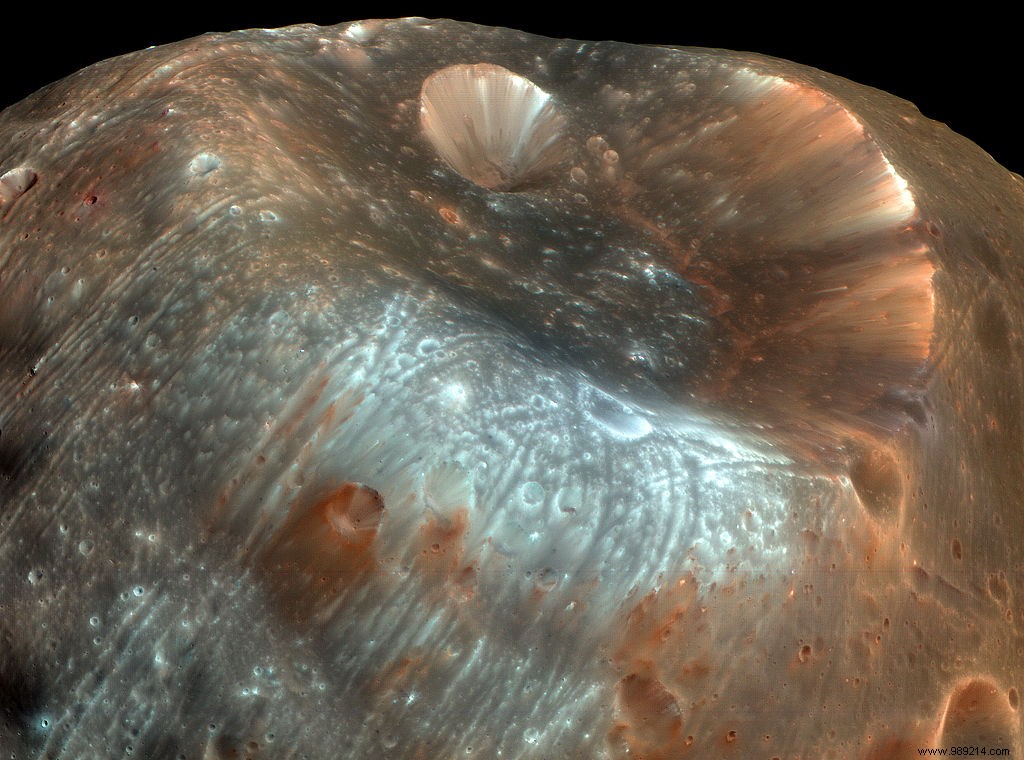
A recent study from JAXA's Institute of Space and Astronautical Science suggests Phobos may preserve traces of ancient Martian life.
Billions of years ago, meteor impacts ejected Martian material into orbit; some reached Earth, like the Allan Hills 84001 meteorite from Antarctica. Phobos likely holds similar ejecta. If Mars was habitable, these could contain biosignatures or fossils.
Researchers Ryuki Hyodo and Tomohiro Usui highlight Phobos' unique value. Perseverance samples Jezero Crater, and ESA's ExoMars targets Oxia Planum in 2023—both promising sites, but limited in scope.
Simulations show Phobos' surface is rich in diverse Martian material from global impacts, offering broader geological sampling and higher odds of detecting ancient microbial life.
