Researchers from Caltech and NASA's Jet Propulsion Laboratory (JPL) have developed a compact biochemical analyzer, roughly the size of a shoebox. This breakthrough device is designed to equip future Mars rovers and planetary explorers.
Identifying traces of extraterrestrial life poses significant challenges for scientists, as the exact signatures remain uncertain. Organic molecules like amino acids stand out as prime biosignatures, yet detecting them is no simple task.
NASA's Curiosity rover, active on Mars since 2012, features about ten instruments dedicated to life detection, including a gas chromatograph, X-ray spectrometer, neutron emitter-detector, mass spectrometer, and CheMin for mineral analysis via X-ray diffraction and fluorescence.
While existing tools struggle with amino acid analysis and offer only partial automation, a study published in Analytical Chemistry on August 25, 2020, details the Chemical Laptop (CL)—a portable miniature laboratory from Caltech and JPL. Measuring just 12 x 24 x 38 cm and weighing 7 kg, it operates fully autonomously.
Powered by a battery and controlled via a simple remote interface, the CL uses off-the-shelf components, plus two microchips: one for sample processing and labeling, the other for compound separation. It employs laser-induced fluorescence (LIF) for detection.
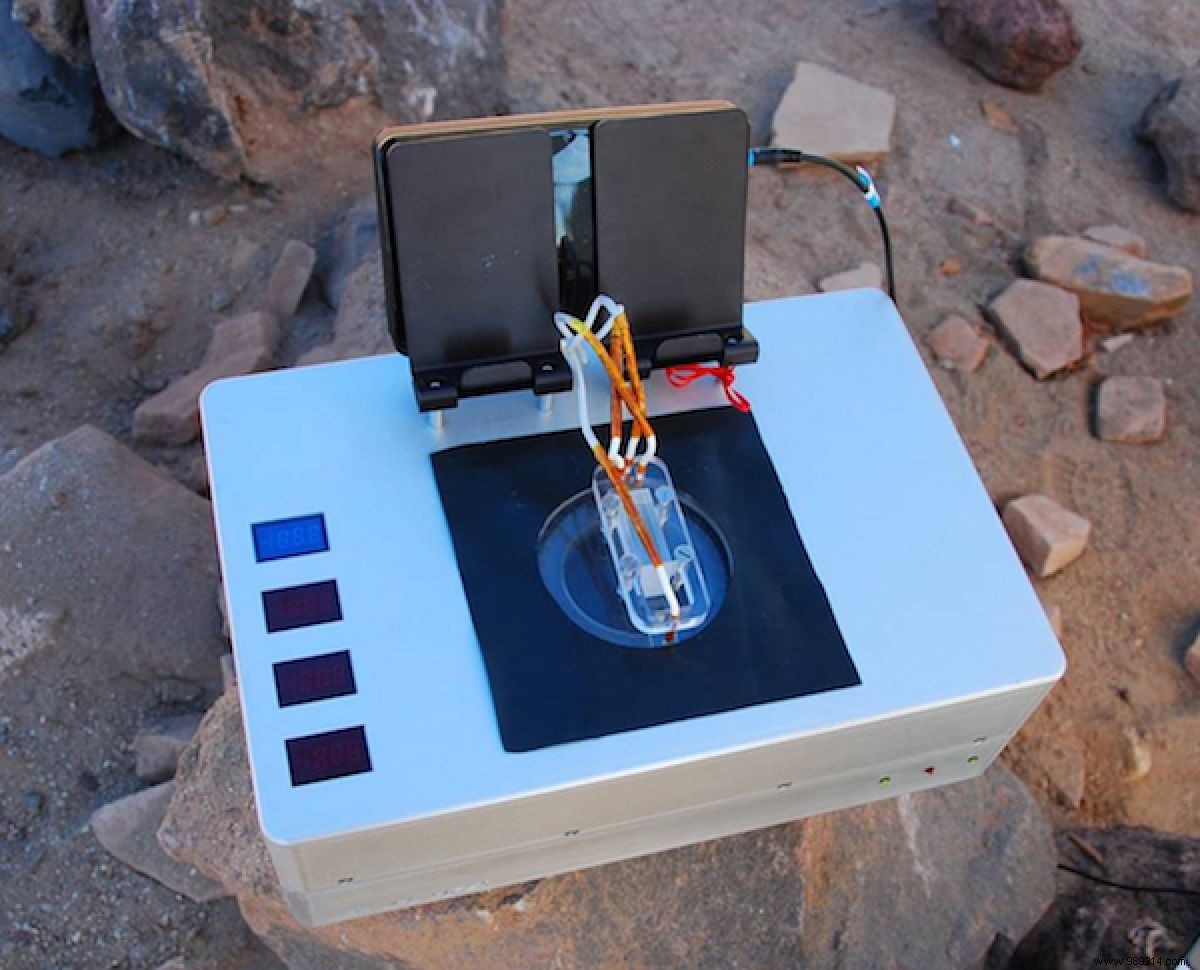
“The CL allows performing labeling, separation and detection of organic molecules, all in a fully automated way”, the study notes.
Tested in a Mars simulation mission in a Chilean desert, the rover drilled soil samples, which were heated with water for extraction. The CL detected amino acid levels in parts per billion (ppb).
Its sensitivity surpasses current gas chromatography-mass spectrometry (GC-MS) methods by three times. Ongoing work focuses on spaceflight adaptations and extraterrestrial durability.
