Astronomers have harnessed an innovative radio technique to investigate activity around nearby red dwarf stars, detecting signals that strongly suggest the presence of four previously unknown exoplanets.
In 2020, researchers observed unusual radio emissions from the nearby red dwarf GJ 1151. These signals were traced to interactions between an orbiting exoplanet and its host star, generating aurora-like phenomena—a process theorized over 30 years ago but observed directly for the first time.
Using the world's most powerful radio telescope, LOFAR (Low Frequency Array), the team scanned one-eighth of the northern sky, identifying radio emissions from 19 red dwarfs located between 12 and 150 light-years away. Two new studies in Nature Astronomy and The Astrophysical Journal Letters provide detailed insights into GJ 1151 and highlight three other potential exoplanets around these low-mass stars.
“This discovery marks a milestone in radio astronomy and holds promise for detecting planets across the galaxy,” says Dr. Benjamin Pope from the University of Queensland.
These four stars are notably quieter than others observed, making their strong signals unlikely without a nearby planet traversing their magnetic fields.
The team draws parallels to Jupiter's moon Io, where decades ago, circularly polarized radio waves were serendipitously detected and later linked to Io's volcanic material interacting with Jupiter's magnetosphere.
Earth's own auroras, borealis and australis, produce similar radio emissions through interactions between our magnetic field and the solar wind.
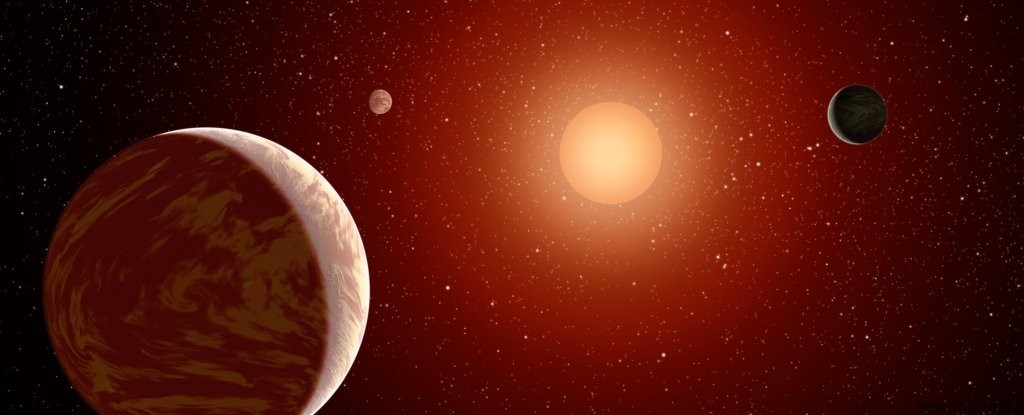
The candidate exoplanets likely orbit extremely close to their stars, with periods of just 2 to 5 days. Despite this proximity, the cool nature of these red dwarfs keeps the habitable zone within reach.
Confirmation awaits further observations. “We can't be 100% certain these stars host planets, but planet-star interactions offer the best explanation for our data,” the researchers note. “This breakthrough could revolutionize exoplanet detection galaxy-wide.”
