Thousands of pieces of space debris orbit Earth at low altitudes. Ground-based scientists meticulously calculate their trajectories to prevent collisions. Traditionally limited to just a few nighttime hours, researchers have now developed a method to track debris continuously—even in broad daylight.
Since the 1960s, Earth's orbit has accumulated rocket stages, boosters, and defunct satellites—tons of debris posing serious risks to the International Space Station (ISS) and operational satellites. While some objects carry reflectors for easy detection, most do not.
Astronomers use ground-based lasers to measure distances and predict paths, averting potential collisions. However, existing methods restrict observations to brief nighttime windows. A study published in Nature Communications on August 4, 2020, introduces a transformative approach. Led by Tim Flohrer, head of the Space Debris Office at the European Space Agency (ESA), this innovation could redefine debris monitoring.
Inspired by the findings, ESA plans to construct a new laser station in Spain's Canary Islands, adjacent to the Optical Ground Station (OGS) telescope at Teide Observatory on Tenerife. The image below illustrates the future debris monitoring network.
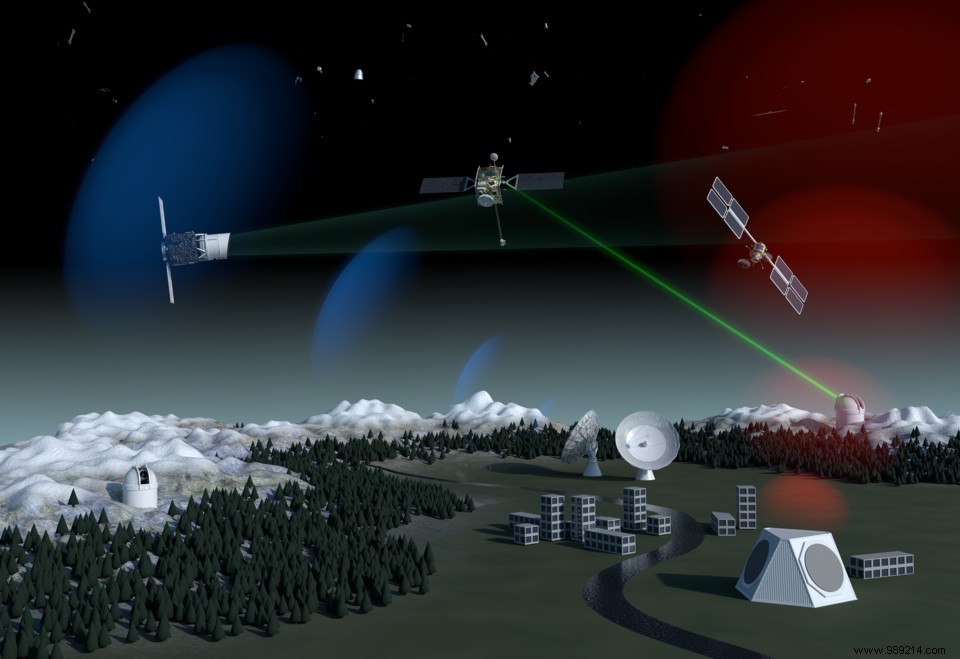
At Austria's Institute for Space Research, experts enhanced debris contrast against the sky using advanced telescopes, specialized filters, and detectors. This allows visibility even under bright blue skies. As detailed in their announcement, the team can now perform laser ranging on previously undetectable objects—around the clock—to safeguard satellites from debris impacts.
“Ultimately, this means we will learn more about the debris population, enabling better protection for European space infrastructure,” said Tim Flohrer.
The researchers successfully ranged about forty distinct debris objects. Their system even detected stars with luminosity ten times fainter than those visible to the naked eye.
